Whether it was established on purpose or by default, every workplace comes with a workplace culture. No two organizations will ever be exactly the same, but the strongest workplace cultures tend to share a few traits: clear expectations, open lines of communication, and strong policies and procedures that everyone knows and follows. A policy management system gives those traits a framework by communicating policies to every employee and giving them a way to respond.
Culture and clarity feed each other. When your team understands the rules and trusts that they’re current, they gain a better understanding of their place in the business and how it works toward a wider goal. The right policy management system works to keep those rules consistent and current, especially in workforces spread across locations, devices, departments, and schedules.
In this article, we’ll look at the components of a strong workplace culture, how a policy management system bolsters that culture, and the specific ways the right automated policy management system will benefit your team.
What Are The Essential Components of a Great Workplace Culture?
An organization’s culture gets formed by the habits and standards your team follows every day – including the ones that aren’t in the handbook. If you want a culture that works in favor of your business and not against it, you should be looking for the following things:
Clarity of Vision and Role
A strong, compliant workplace culture begins with the people themselves. To that end, how clear are your employees on what they should be doing, and what their best work looks like?
Your workforce should fully understand their roles and their responsibilities. That includes how they operate on a day-to-day basis, and within the grander scheme of the company. Workers need purpose to fully occupy the role of an efficient, motivated, and productive employee. Understanding facilitates that purpose.
Open Communication
Clarity is impossible to achieve without strong, open lines of communication. Tell your employees what you expect of every member of the team, and why the role they occupy matters.
Good communication starts with plainly defining expectations for employees, clearly communicating them, and then keeping those guidelines somewhere accessible, so everyone can easily use them as a reference if needed.
Mechanisms for Meaningful Feedback
But what if a new policy doesn’t gel well with how your business runs? Or, what if the wording on a recently updated procedure is too complicated for most of your employees to understand? How will you know?
Communication can’t be a one way street. You need to give employees ways to share feedback and ask questions, or you’re not actually communicating with them. Workers that don’t feel like their input is seen, heard, or valued aren’t ones that stick around, and they don’t contribute to a positive, healthy company culture, either.
Make sure channels exist for people to provide feedback on what works and what doesn’t, or to ask questions when they don’t understand something. Then make sure everybody knows what those channels are, and how to use them.
Then take that feedback, and…actually use it. If you discover that employees like the way a policy is being implemented, good. If it’s widely communicated that something isn’t working, fix it. Maybe that looks like rewording a policy or procedure, changing the way it’s enforced, or offering training to give everyone a better understanding of the material.
By encouraging people to share their feedback, and consistently acting on that feedback, you establish a pattern of constant improvement, and a workplace culture where employees feel like what they have to say actually matters – because it does.
Policies Everyone Knows and Follows
Policies and procedures create the framework on which an organization is built. They translate company values and expectations (as well as industry-wide legal and regulatory mandates) into specific guidelines employees are expected to follow.
Your policy management system then (ideally) houses those policies in one location, keeps them current, and makes them easy for everyone to find, and follow.
But before we go any further, let’s ask and answer one question.
What, Exactly, IS a Policy Management System?
When we talk about policy management systems, we refer to dedicated policy software that a business uses to create, store, distribute, and track the policies and procedures that guide employees’ work. The software system digitally stores all policies in a central, accessible location and keeps each version current, ensuring that everyone (literally) stays on the same page.
A policy management system generally handles these core tasks:
- Managing the full policy lifecycle, from creating and crafting new policies to storing them
- Distributing policies to the people who need to read, understand, and acknowledge them
- Recording who has read and acknowledged each policy
- Testing employee comprehension of policies and procedures
- Flagging policies for review before they become outdated
What if My Business Keeps Going Without One?
Organizations without a proper policy management system in place court a high amount of risk, whether they realize it or not. When companies keep policy documentation, including employee acknowledgements, in dusty filing cabinets or electronically buried in disparate email threads and spreadsheets, the problems start.
Multiple versions of the same policy circulate without a clear source of truth. Employees who fail to acknowledge policies slip through the cracks without anyone noticing. Outdated policies stay in effect without anyone to review and update them. Audits throw everything into chaos, because there’s no real system for organization.
The worst part is that you have no real visibility into what’s going on, so you might not even realize how big the problem is until it’s too late. And “too late” can look like a number of things, from fines to regulatory or even legal trouble. Those breaches don’t signal great things for your organization’s reputation or client relationships, either.
And all of that trickles right down to your hardworking employees. When you don’t provide them with a clear pathway for success, you’re setting them up for failure. It’s not great for morale, and your company culture becomes one defined by stress, chaos, and confusion. The employees you value most won’t stick around in an environment like that. And why should they?
How a Clear Policy Management System Gives People Purpose
Instituting a policy management system establishes a clear, organized system for creating, referencing, and updating policies and procedures. It also keeps teams informed and in the loop, in turn providing them with a greater sense of purpose behind the day-to-day responsibilities of their jobs.
Morale and Cohesion
A policy management system exists to keep every employee equipped and working from the same standard, and you’ll see that immediately reflected in the morale of those employees.
A team that feels well-prepared and well-informed about what they’re trying to achieve is a team that holds together better. People who trust that their employer is giving them the tools they need to do the job well tend to stay at those jobs longer, reducing turnover.
Absenteeism also takes a dive when employees truly feel accountable to the company and the colleagues that count on them. Hiring gets easier, too, because an organized, well-run business attracts people who want to do good work.
Better Coordination
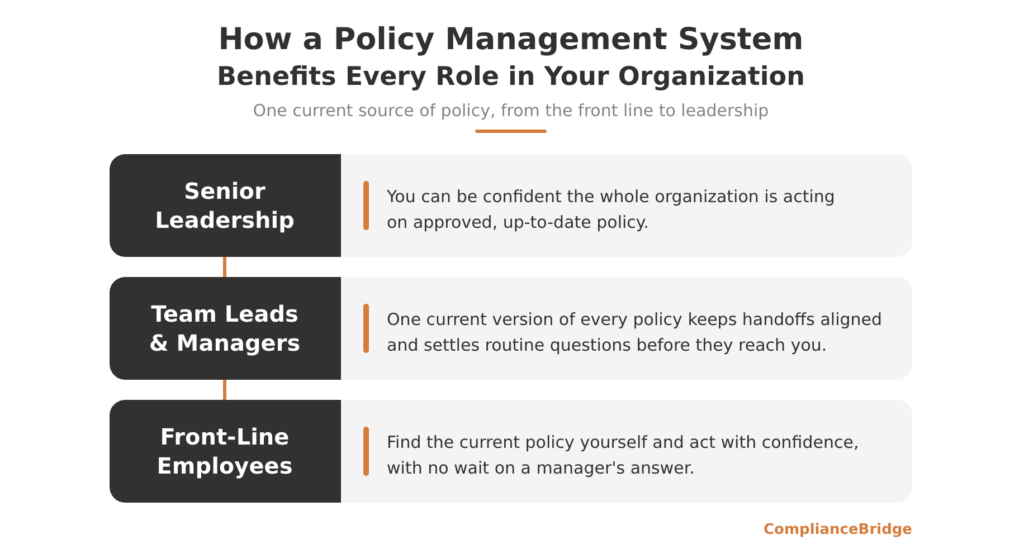
When everyone references the same policy management system, teams stop losing time to conflicting versions and outdated information. With one reliable, current source across the entire business, you can trust that a decision made in one department matches the standard every other department follows, keeping handoffs between teams and departments smooth.
For workforces spread across locations, devices, and schedules, that shared reference keeps people aligned, even when they work from separate places.
Speed and Efficiency
Clear, organized policies let people make faster, better-informed decisions. A policy management system makes guidance easy to find, so employees can answer routine questions on their own without escalating every call to a manager.
Where more senior staff do need to get involved, they have the reference to make decisions quickly. Fewer stalled decisions means fewer disputes, and less time wasted waiting on an answer.
Lower Risk and Better Compliance
Using policy management software, you can automatically require employees to acknowledge each policy and confirm they understand it, and get notified when employees miss this step. You can follow policy updates with short comprehension tests, so you know first-hand that everyone understood it.
In regulated sectors such as finance and healthcare, having that record matters. If an auditor asks for proof that staff received, read, and understood a policy, you’ll have the corresponding documentation ready to go, shielding your organization from lawsuits and fines.
Modern Problems Require Software Solutions
A strong workplace culture rests on the kind of transparency that a policy management system is built to provide. And if you’re looking for the best possible policy management system for your organization, you luckily won’t have to look far.
ComplianceBridge’s Policy and Procedure Management software provides businesses with an automated, end-to-end solution for managing the full policy lifecycle.
Using ComplianceBridge, stakeholders across an organization can collaborate on a single, central policy document with clear ownership and version controls, templates for standardization, and customizable workflows, to meet the unique needs of your company.
Those stakeholders can build, save and reuse review workflows that move policies through approval. Once approved, our targeted distribution system sends policies to the right individuals, groups, or locations with the press of a button. The system then allows you to track acknowledgment and, when necessary, gauge employee understanding with customizable comprehension quizzes.
Automatic reminders, review dates, and expiration dates keep people and policies compliant, while our internal Document Management system tracks and stores everything you need to stay audit-ready at all times.
Our policy software also generates metrics based on responses in real time, and gives management the option of generating reports for further analysis and review.
To learn more about what our top-notch policy management system can do for your business, contact ComplianceBridge for a demo today!
Request a Demo Today
See our product in action with your own private demo. During the live demo we cover key functionality plus any detail you want. Pick your date and time now, and let us know what is most important to you.