How confident are you that nothing is slipping through the cracks in your organization? Between the policies and procedures you maintain, risks you track, and regulations you answer to, the sheer volume of moving parts can overwhelm the systems meant to keep them in order. Governance, risk, and compliance, or GRC, refers to how a business makes sound decisions, manages threats, and meets legal and regulatory obligations. GRC software is the platform that holds all of those activities in a single connected system.
GRC solutions matter because of what can happen when you don’t use them. Falling out of compliance or failing to negate risk, especially in industries like healthcare and finance, can lead to harsh penalties, up to and including legal action.
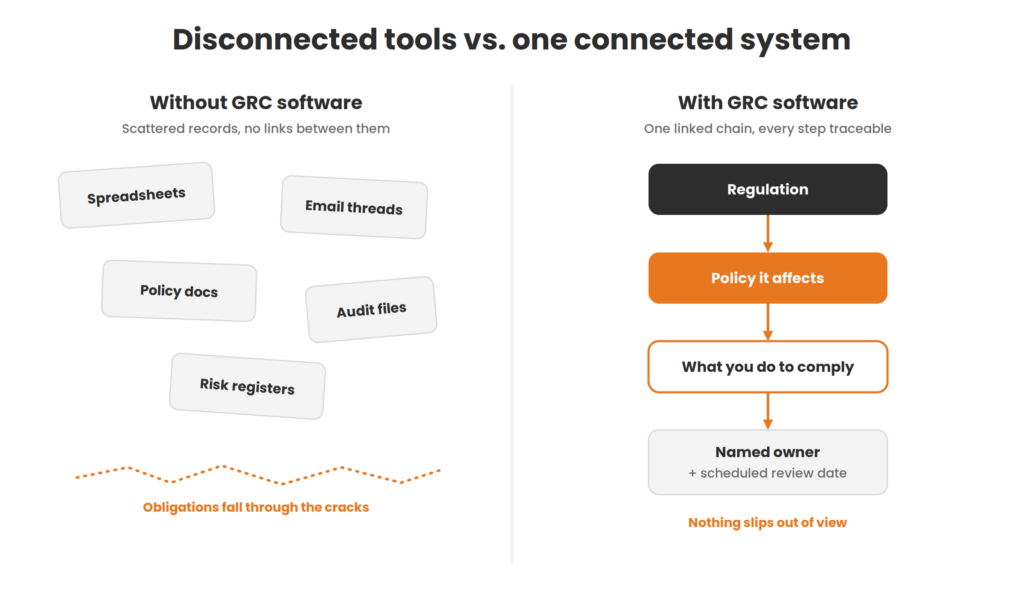
For this reason, most companies have implemented GRC in one form or another, but the delivery system for GRC matters. When these responsibilities live in scattered spreadsheets, labyrinthine email threads, and separate department tools, cracks start to form. Obligations get missed, work gets duplicated, and no one has a full view of where the organization stands.
In this article, we’ll take a closer look at GRC software, what it does, and why it matters for your business.
What is GRC Software?
Governance, risk, and compliance function best as one interconnected discipline:
- Governance sets the directions and controls that keep decisions strategically and ethically aligned. (Ex: Managing the full lifecycle of workplace policies and procedures)
- Risk management identifies threats (such as conflicts of interest, also known as COI) that could disrupt operations.
- Compliance keeps the organization within its legal, regulatory, and contractual obligations. (Ex: Incident reporting, corrective action planning)
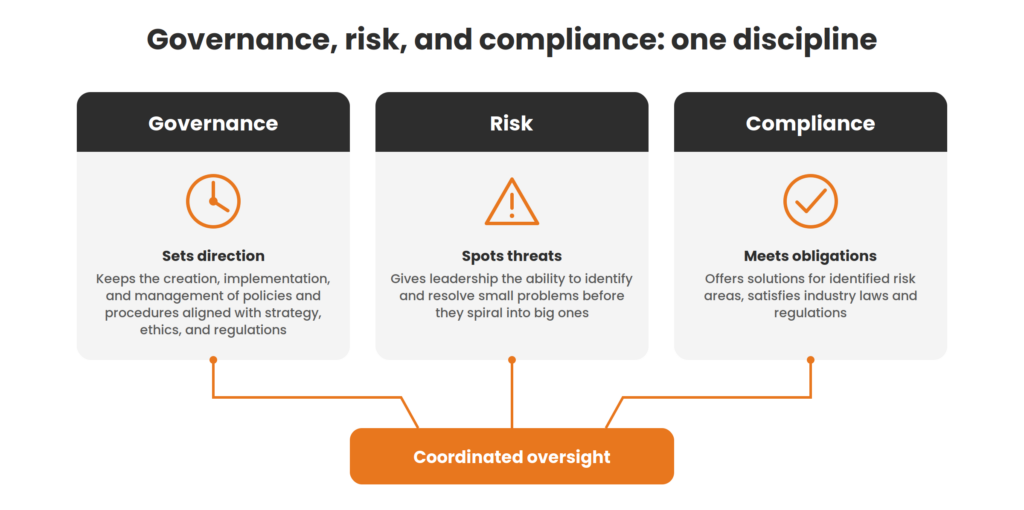
When governance, risk, and compliance work together, they reinforce each other, creating a self-strengthening cycle of continuous compliance. GRC software safeguards this cycle by bringing them into a single structured system. Policies, risks, audits, and regulatory requirements share one home, so everyone within an organization works from the same information.
Using GRC software, a compliance officer can visualize how risk interacts with the controls meant to address it. A risk manager can trace a regulatory or legal change to the policies that change impacts. Shared visibility and transparency separate a collection of tools from an actual working platform.
In practical terms, GRC software helps teams:
- Identify risks and assign clear ownership for each one
- Document controls, and link them to the policies they support
- Monitor compliance obligations across roles and departments
- Generate reporting on performance without having to chase data through email threads and spreadsheets
When a new risk surfaces, GRC software platforms can map it to the relevant policies, controls, and mitigation plans already on file. When a regulation changes, you can evaluate how the update affects your existing controls before compliance lapses. When leadership asks for a status update, you can produce it from one source. You receive a working, unified picture of where your organization actually stands, with the audit trail to prove it.
Consider this scenario: a new data-privacy regulation gets passed in your industry. In an organization without a comprehensive GRC software, the reaction to this regulation is a manual one. Somebody has to figure out which policies that regulation affects, track down how the business currently applies those policies, and judge whether the new regulation opens up an operational or compliance gap you’ll now have to close.
In an interconnected GRC management system, that trail is already built. Each policy is tied to the rules, regulations, and laws behind it. When something changes, you can immediately see which policies are impacted, what those policies currently require, and who carries the responsibility for updating them. You get the full picture immediately. That visibility can mean the difference between capturing a problem early, and discovering it during an audit.
Why Does Your Business Need GRC Software?
Many companies that choose GRC software tend to do so at a specific moment: when the complexity of GRC management starts to outpace the capabilities of manual systems. Sometimes that moment arrives during growth, expansion into new markets, rises in regulatory scrutiny, or in the aftermath of a compliance lapse.
An organization that cannot see its own risk posture exposes itself to liability. When that exposure grows, informal processes become harder to defend. Leadership needs visibility into where the organization actually stands. Regulatory bodies expect documented proof that governance is more than an intention. That’s hard to do when your evidence lives in peoples’ memories or across a dozen versions of the same file.
Think about what always happens in the wake of a serious compliance breach. When something goes wrong, the questions start coming in fast. What happened? Who knew? What policies applied here? What did you do about this?
Organizations that run on scattered, disorganized systems (or no system at all) spend the days after an incident trying to assemble the story from fragments. It’s difficult, time-consuming, and alarmingly imprecise work.
Structured, connected software systems eliminate that disorganization and ambiguity because they hold that record for you. If something happens, you can have concrete documentation of what policies were in place, who they reached, and the corrective action underway.
GRC software gives businesses a structured framework for accountability. It consolidates work that would otherwise sprawl across departments and tools. In doing so, organizations receive clearer oversight, stronger coordination across departments, and a much lower level of complexity.
The deeper benefit is a shift in how your team spends its time. When you are gathering compliance data by hand, the work is, by nature, reactive. Most of your effort goes into finding and assembling information, so your team stays a step behind, always responding to problems that have already surfaced.
GRC software gathers and organizes that information automatically, so compliance and risk professionals can focus on analyzing what the data is actually telling them. With that reduced load and greater insight, their work becomes more proactive, helping teams identify small problems before they escalate into huge ones. That change, from tracking to managing, is what most organizations are really buying when they invest in a platform.
What Should You Look for in GRC Software?
Once you recognize that adopting a GRC software platform makes sense for your business, next comes deliberating which option would be the best fit for your organization. How do you tell a strong GRC platform from a weak one?
Here’s seven criteria to consider.
Framework
Start with the actual framework of the GRC software. You’re looking for a platform that holds governance, risk, and compliance data in one connected repository, so a risk record, the policy that addresses it, and the control that enforces it all reference one another. When that data sits in separate systems, it creates another version of the fragmentation you were trying to escape.
Risk Capabilities
How does the GRC software option you’re considering handle risk? Good GRC software gives users the tools to build and revise assessments and audits that identify and work to mitigate risk. Those tools should also assign risk levels, so teams can know to prioritize higher-severity findings over more minor instances.
Conflict of interest represents one of the most common and pervasive threats to the integrity of a business, so thorough GRC software solutions should include the necessary tools to manage COI. Comprehensive COI management includes avenues for employees to disclose potential conflicts, both as part of regular reviews and on an ad hoc basis.
Documentation
Does the GRC management solution you’re considering have mechanisms for thorough, accurate recordkeeping? If not, it’s not the right one for your organization.
The GRC software your business uses should produce a clear documentation trail, with every change, approval, and result stored automatically. In the event of an audit, you’ll never have to stress or scramble to get clean, organized records ready, because they’ll already be in the system, ready to go.
Distribution
Weigh how the platform actually gets new and revised policies and procedures in front of people. The best GRC software supports targeted distribution, sending policies and procedures to exactly the people who need to see them.
Automated software also tracks acknowledgement and can send reminder notifications, keeping stragglers from getting skipped. GRC software can also produce and store documented proof that your workforce knows and understands company policy. High-level oversight into distribution provides an audit trail, and it also helps foster a company culture of accountability; When employees know you take compliance seriously, they will, too.
Reporting and Visibility
Strong GRC platforms give users the proper tools to collect and analyze crucial data. Real-time dashboards let members of leadership know where their operation stands at a glance. If an issue arises, they’ll know about it in as close to real time as possible. Company leadership also benefits from the option of using generated data and analysis to produce exportable, customizable reports.
Integration and Adaptability
How effective can a platform be if it doesn’t work well with your company’s existing structure? The right GRC software for your business needs to be able to connect with the tools you’re already running, and adjust as laws and regulations change.
Poor system integration and limited adaptability rank among the most common frustrations for buyers, so pressure-test both before you commit.
Configurability
You need a platform that grows with you. Look for GRC software configurable enough to match the way your organization actually runs. That way, you can build your own question sets, forms, reports, and workflows around the processes already in place.
ComplianceBridge is Built for GRC
The case for GRC software is one thing; finding a platform that actually delivers on it is another. ComplianceBridge meets that standard, offering a unified GRC Management Suite, configured to how your organization works.
Governance
Our Policy and Procedure Management system streamlines the creation, implementation, and review of workplace policies and procedures. Using version controls and targeted distribution, you can be sure that the right people will always receive the right documents.
Automated notifications and reminders keep things from stalling without requiring managers and admin to manually notice and track down stragglers. And our real-time dashboard metrics let you know where your policies stand at any moment.
Risk
CompanyMileage has tools for auditing and assessing risk, as well as for disclosing and managing conflict of interest. Users can create, copy, and revise question sets, assign risk levels, and distribute assessment to different groups simultaneously. Results populate the analytics dashboard as they come in.
Compliance
Our customizable Incident Report and Corrective Action Plan templates keep you from having to build forms from scratch. Users customize each one, attach automated workflows that route the work, and stored documentation keeps everything audit-ready.
When our ready-made forms don’t cover what you’re looking for, just turn to our Dynamic Workflow Forms! Built unlimited forms through a no-code menu, with a variety of diverse formats. These are also highly customizable, so you can tailor them to your brand.
A Single Solution
Underpinning all of this is ComplianceBridge’s dedication to customizability, reliability, and compliance. Our Document Management System tracks and records every change, approval and result, keeping you audit-ready at all times.
Every subscription includes a dedicated Client Success Manager, onboarding personalized to the branding of your business, and a database protected by multi-layered security, regular penetration testing, and daily server backups.
To learn more about the ways our GRC tools can benefit your business, book a 1:1 demo with ComplianceBridge today!
Request a Demo Today
See our product in action with your own private demo. During the live demo we cover key functionality plus any detail you want. Pick your date and time now, and let us know what is most important to you.