Transparency and integrity are crucial elements of any successful business. Companies that operate with these qualities build and maintain trust with their customers, employees, and stakeholders. One area where transparency and integrity are vitally important is in managing conflict of interest disclosure. Conflicts of interest can arise in any business setting and if not managed effectively can threaten a company’s reputation – and its bottom line.
To maintain transparency and integrity in their operations, companies must have a robust conflict of interest disclosure process. Avoiding employee conflicts of interest entirely just isn’t possible, so it’s crucial that when a potential conflict does arise, it is handled responsibly.
So how can a company navigate conflict of interest disclosure in a way that reassures stakeholders and protects the business from liability? In this article, CompanyMileage will explore potential challenges posed by conflict of interest disclosure workflows, why having a clear and competent system in place for dealing with conflict of interest is essential in the business world, and what that system might look like.
Conflicts of Interest Are More Than Just Policy
A conflict of interest describes a situation in which a person’s personal or financial interests conflict with their responsibilities to their employer. Conflicts of interest can manifest in the workplace in a variety of ways and forms, including through familial or romantic relationships, dual employment, shared clients or vendors, and so on.
Workplace COI can seriously compromise, or appear to compromise, an individual’s objectivity and judgement. Biased decision-making stemming from these conflicts can have serious ethical implications. When this happens, it doesn’t happen in a vacuum either; on the contrary, improperly handled conflicts of interest allowed to run rampant in an organization can expose that organization to regulatory, reputational, or even legal damage.
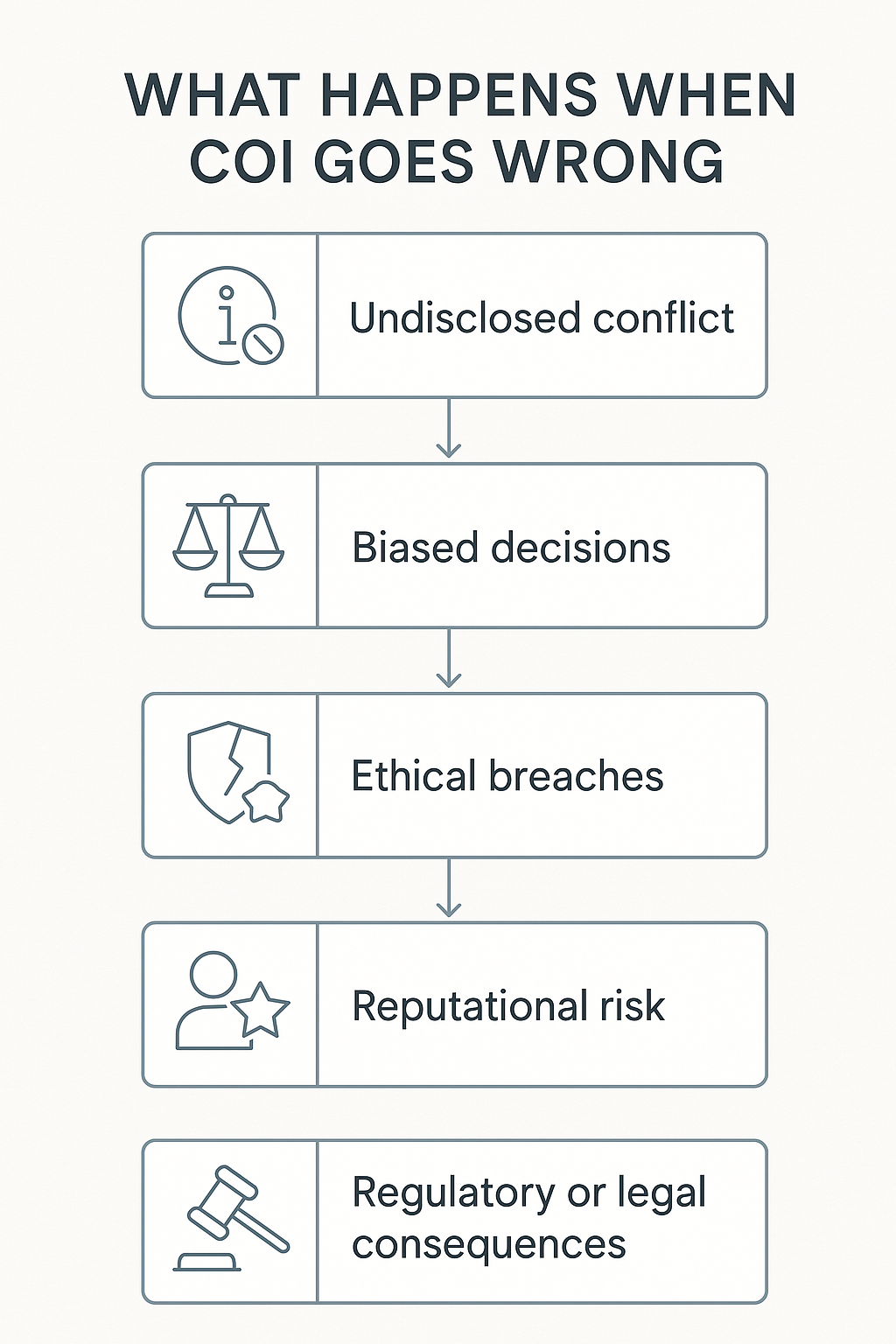
Disclosure serves as a way for employees to share conflicts, or interests or relationships that have the potential to become conflicts, before they can undermine trust, morale, or fairness. However, organizational avenues for conflict of interest disclosure only work when employees actually use them, and use them properly.
Why Disclosure Processes Might Need Fixing
If conflict of interest disclosure is so important, what might keep employees from disclosing? Often, the culprit for underdisclosure lies in the current systems for disclosure a company has in place. Here are some tell-tale signs of a “bad” conflict of interest disclosure process – or at the very least, one that could use some updates.
Too Much Bureaucracy
Who wants to get tangled up in red tape? Ineffective disclosure processes are often circuitous and time-consuming, requiring employees to hunt through HR portals, PDFs, or old emails just to find the right forms. Processes that overrely on paper or spreadsheets, or require back-and-forths of printing, signing, and reuploading forms also have a tendency to overcomplicate things.
Another conflict of interest disclosure red tape red flag? Poor communication, or a lack of communication at all. If you don’t tell employees where to disclose, deadlines for disclosure, or your company’s expectations for what conflict of interest disclosure entails, you’re setting them – and your organization – up for failure.
Overly Complicated
Less-than-effective disclosure workflows are often less-than-intuitive. When you overcomplicate conflict of interest disclosure, you run the risk that employees won’t understand how to disclose, or get too overwhelmed and not bother at all. This includes long forms, overwhelming amounts of legal jargon, overly broad or vague questions, and unclear definitions. When employees don’t know exactly how to define a conflict, or what one entails, they tend to either underreport or overdisclose out of fear.
A “One-and-done” Philosophy
Consider updating your conflict of interest disclosure process if disclosures only occur once a year, without reminders sent out to update employees when circumstances change. Conflict of interest disclosure should be an ongoing risk management activity, not just a rote box for managers to mark on a compliance checklist. “One-and-done” disclosure processes also run the risk of collecting compliance data and then not actually using it. When data sits unused that means no one follows up on new information, reviews trends, or reported conflicts. Which is….pretty the exact opposite of what a good disclosure process should do.
Lacks Leadership Support
Strong processes require strong leadership! Executives who don’t model proper behavior around conflict of interest disclosure, or who treat compliance like a task for HR instead of a vital company value, undermine the credibility of the entire process. Without leadership buy-in, workers will assume that disclosure doesn’t really matter, and they might even be right.
What a Truly Easy Disclosure Process Looks Like
The above is a list of factors that can make conflict of interest disclosure difficult, frustrating, and…well, think of your own synonym for “not great” and insert it here. Now, let’s get more optimistic with some ways your organization can help make disclosure way easier for employees, and way better for overall compliance.
Keep it Simple, Stupid!
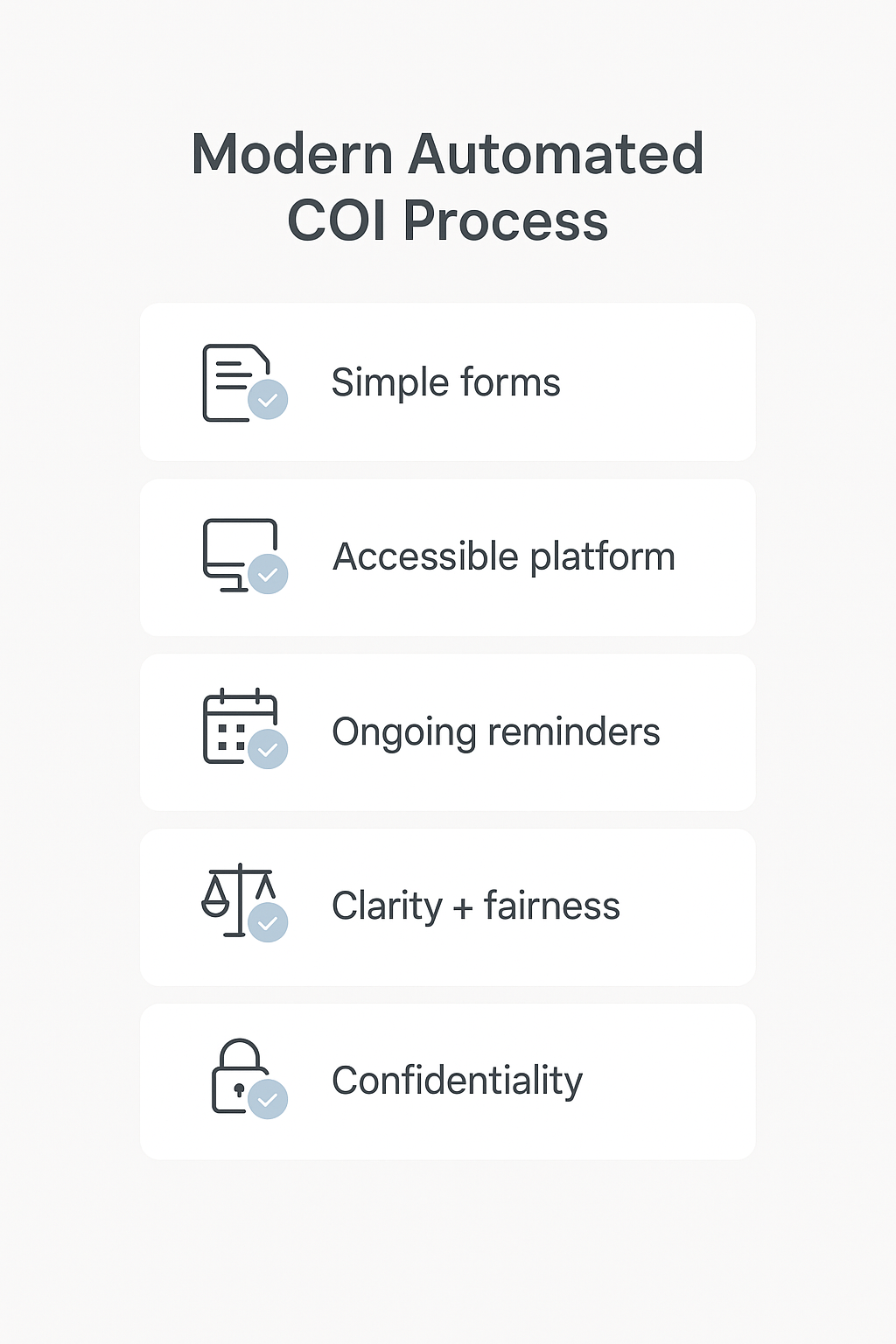
COI documents and forms for employees should be written for those employees, not for compliance officers. Prioritize employee understanding by using clear language, asking simple, specific questions, and defining all necessary terms. Communicate to workers exactly what needs to be disclosed, and why.
Another vital way to ensure that employees have a firm understanding of what conflicts of interest are and how they should be handled is by providing regular COI training, covering common examples of workplace conflicts of interest and the circumstances in which they arise. Conflict of interest disclosure training should also cover the unique consequences of conflicts both individually and on the business as a whole.
Keep it Accessible
Don’t hide your conflict of interest disclosure process under a bushel! Whatever form your company’s COI disclosure process takes, make sure that it’s easy for workers to find and access, and intuitive for them to use. For a growing number of organizations, this entails eschewing spreadsheets or pen-and-paper-heavy workflows for electronic portals or mobile/desktop friendly platforms. Easier, painless processes encourage higher participation, resulting in fewer oversights, and a stronger culture of integrity and transparency within your workplace.
Keep it Going
Instead of using an annual model for conflict of interest disclosure, consider making it an ongoing process. That way, employees have the ability to make or update disclosures whenever circumstances change.
Keep it Clear…
Successful workflows require transparency! Focus on a solution for conflict of interest disclosure that allows for visibility in acknowledgements, in review, and in any outcome.
…But Keep it Fair
Transparency is important, but so is fairness! While COI processes should have a high level of transparency and visibility, they should also protect employees’ confidentiality, and be as fair to all workers as possible. Employees should always feel safe to disclose conflicts without having to worry about bias or unfair consequences.
Keep it Continuous
The best employee COI processes operate as an ongoing, continuous feedback loop of disclosure. In the best systems, employees know their disclosures are valued, addressed, and managed, just not noted and filed away. Companies that are proactive about conflict of interest disclosure, including in actually evaluating and following through on employee responses, create an environment that encourages other employees to disclose conflicts as they arise.
Keep it Automated
Manual management of conflict of interest disclosure can be slow and inefficient, involving chasing down negligent employees for responses and shuffling paperwork. Maybe it’s time for an upgrade! Conflict of interest software automates disclosure, using system-based prompts to set regular reminders and notifications for disclosure, reducing administrative burden.
Key Features Organizations Should Prioritize
As the global business world gets smaller and tech-savvier, more and more businesses are seeing the benefits of automated solutions for conflict of interest disclosure. With so many COI software options out there, here are some things to look out for in the best solution for your company’s conflict of interest disclosure processes.
Customizable
No two companies are structured exactly alike, even companies in the same industries. Solutions for conflict of interest disclosure should be customizable to meet the needs and existing workflow of your business. For instance, COI questionnaires offered by this software should be easy to tailor for different roles, locations, departments, and fields.
Integrations
Any solution you choose should be able to play ball with systems your company already has in place! Be on the lookout for conflict of interest disclosure software solutions that integrate with existing company HR and compliance systems. Seamless integration will ensure COI processes go off without a hitch.
Real-Time Reporting
More advanced systems means faster reporting! Conflict of interest disclosure software monitors and records responses in close to real time, something even the most dedicated HR rep would struggle to do. Software takes this collected real-time data and organizes it into dashboard displays and analytics reports. These provide insight into company disclosure completion rates, while making it easier for leadership to spot and isolate reporting trends and red flags.
Employee-Conscious
Faster, smarter, more intuitive systems for conflict of interest mean fewer headaches for your organization’s hard-working employees. The right software options offer employees a simple, easy-to-use interface that lets them thoroughly disclose possible conflicts of interest with minimal time investment.
ComplianceBridge is Your COI Roadmap
Conflict of interest disclosure is too important, and too comprehensive to handle manually. That’s why ComplianceBridge created our COI software, which streamlines and automates conflict of interest disclosure.
ComplianceBridge takes care of the heavy lifting by allowing companies to create custom question sets that suit the business’s unique needs. The software supports a wide variety of question types, including short answer, multiple choice, yes/no or true/false, fill in the blank, and ranking. Employers can also add conditional questions, which only appear depending on how a previous question was answered, and weighted questions to give certain answers more importance during scoring.
ComplianceBridge makes it simple to schedule collection periods, so they can be made to recur at regular intervals. Our software displays results in real time, making it easy to identify trends and spot areas that may need more focused attention. Our real-time reporting and analytics dashboard also lets organizations use collected data to generate reports and export them for further analysis in other applications or for presentations.
ComplianceBridge’s COI management software is a powerful tool for helping companies manage the spectrum of conflicts of interest disclosure. By providing a centralized location for employees to disclose potential conflicts, and automating the process of evaluating and addressing conflicts, our easy-to-use software can help companies maintain transparency and integrity in their operations.
To see it in action, request a demo with ComplianceBridge today!