Policy and procedure management software now sits at the center of how organizations communicate rules, manage risk, and keep people aligned. This means the choice of platform shapes daily work as much as any written policy. Employees expect to find clear, current guidance quickly whether they work on-site, fully remote, or hybrid. Leaders need reliable evidence that policies are up to date, approved, and understood, especially when regulators, auditors, or boards ask difficult questions.
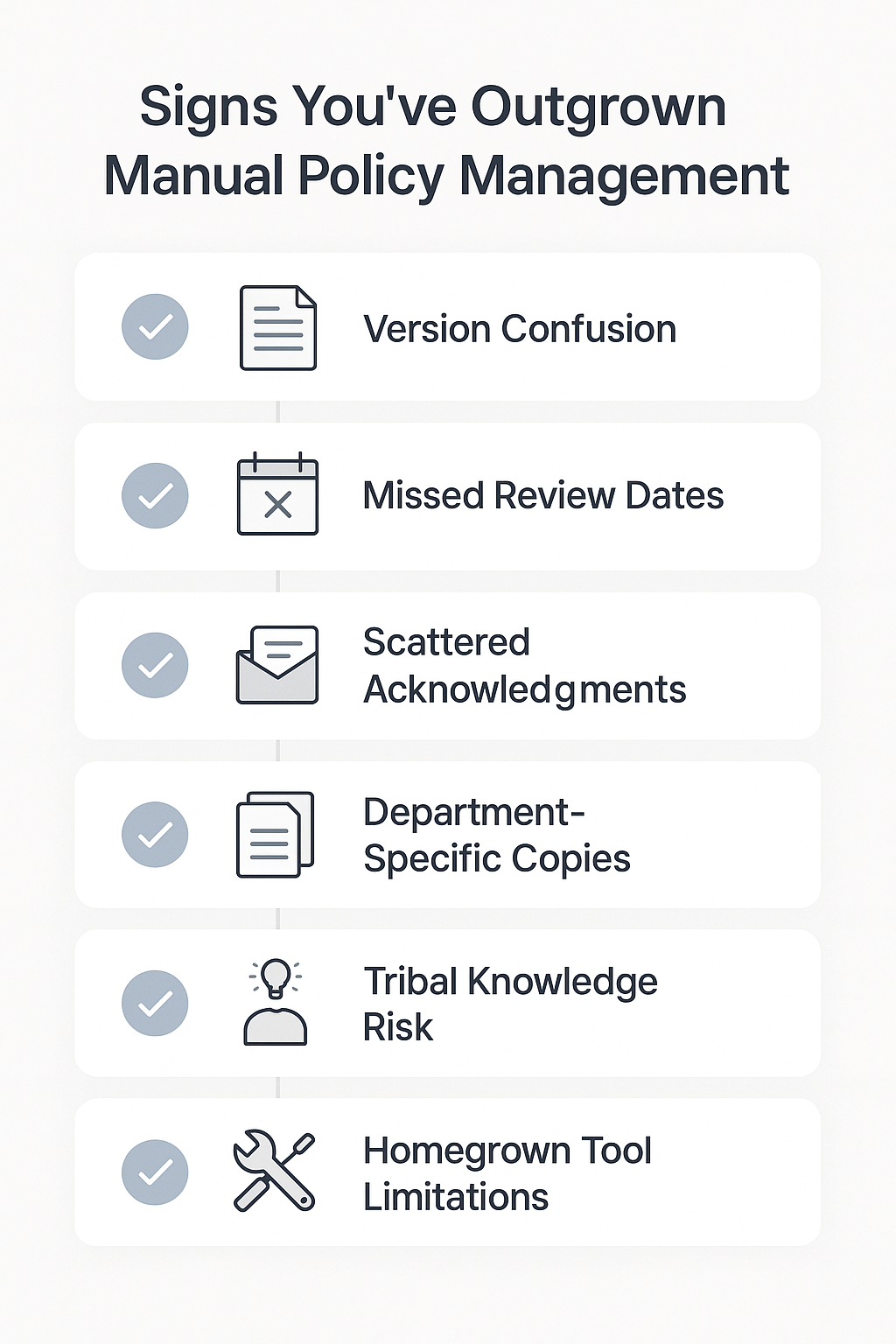
Many organizations still rely on spreadsheets, shared drives, email chains, or homegrown tools, but these informal systems break down as staff counts, locations, and regulatory expectations grow. Version confusion, missed reviews, and scattered acknowledgments become common pain points, revealing a deeper core issue; manual processes make it difficult to prove who saw what, when they saw it, and what was approved by whom.
Recognizing When It’s Time to Invest in Policy and Procedure Management Software
Early-stage or smaller organizations can often limp along with improvised policy systems, but warning signs appear as complexity increases. Departments are restructured, org charts get rearranged, acquisitions occur, new employees are hired, and without a robust, reliable policy and procedure management software serving as the skeleton, different departments tend to keep their own copies of policies and no one is quite sure which version is “live.” Policy review dates are tracked in personal calendars or spreadsheets, making it easy for important reviews to slip.
Homegrown systems built on tools like network drives or basic portals create hidden dependencies and risks over time. A few technical staff members or compliance champions emerge as the only people who know how the system is stitched together, but when they leave the organization, this “tribal knowledge” tends to evaporate—or at best, gets significantly diluted. Enhancements, bug fixes, and integrations compete with other IT priorities and may never get done, revealing not only a simple sprain in the system, but broken bones.
The root issue needs surgical realignment, not a compression wrap. Moving to dedicated policy and procedure management software should be treated as a chance to simplify and standardize, not just replicate today’s problems in a new interface. This starts with an evaluation process that polls pain points and details desired outcomes, not just a long wish list of features. The four considerations that follow give a structured way to compare options and avoid common pitfalls.
Consideration One: Implementation, Training, and Ongoing Support
Implementation quality and after-sales support often matter more than any individual feature because they determine whether the software actually gets adopted. A rushed rollout can increase frustration and make staff nostalgic for the old, inefficient system, broken as it was. On the other hand, an intentional, well-planned rollout with a smooth transition and adequate training turns policy and procedure management software into a trusted, everyday tool.
You should treat training and onboarding as essential components of the offer, not as a minor “add-on” at the end of the sales conversation. Inquire how your chosen vendor trains different audiences: administrators, policy authors, approvers, and end users. Clarify whether new staff will have access to ongoing training through webinars, short videos, or self-paced modules. Understand what is included in standard support (response times, channels, hours, and escalation paths). Ask what triggers extra fees, such as custom configurations, integrations, or hands-on help with imports.
The upgrade and enhancement model should ensure that your policy and procedure management software keeps improving without forcing you into constant re-implementation. Confirm whether new releases and features are included in your subscription or require separate purchases. Learn how upgrades are rolled out, tested, and communicated, and whether they disrupt daily work.
Consideration Two: Fit for Your Sector, Regulations, and Everyday Workflows
General-purpose tools can appear attractive, but policy and procedure management software that already fits your sector can reduce configuration time and risk. Law enforcement, healthcare, finance, higher education, and local government each bring distinct compliance and documentation needs. A “jack of all trades” tool may require extensive customization to reflect your environment.
The platform should support your regulatory obligations rather than forcing you to work around its limitations. Look for the ability to map policies and procedures to specific regulations, standards, or internal controls. Ensure that the system can generate audit-ready evidence of approvals, reviews, and staff acknowledgments. Day-to-day workflows should feel natural for your policy owners and staff, not like an awkward process bolted on top of existing work.
Drafting, review, and approval workflows should match your actual chains of responsibility, including exceptions and parallel approvals. Role-based access and views should allow staff to see only the policies and procedures relevant to their jobs, locations, or departments.
A good sector fit includes both configuration and vendor understanding of your real-world environment. Ask for examples or case studies from organizations similar to yours to see how they structured their policy library. In policy and procedure management software demos, ask vendors to show how typical scenarios in your sector (such as incident response updates, safety bulletins, or new regulatory guidance) would flow through the system.
Over time, a strong match between software and sector makes it easier to scale policy and procedure management without constantly rethinking the structure. New regulations and organizational changes can be incorporated by adjusting existing categories and workflows instead of starting over.
Consideration Three: Security, Governance, and Technical Foundations
Policies and procedures often describe sensitive internal processes, so the policy and procedure management software must protect both access and integrity. Role-based permissions and integration with your identity provider (SSO, MFA) should be standard expectations, not extras. Encryption in transit and at rest, along with strong authentication, reduces the risk of unauthorized access.
Governance capabilities ensure that content stays accurate and managed over time instead of drifting into a “set it and forget it” state. Each policy should have an owner, a status, and a review date visible inside the system. The platform should automate reminders and escalations when reviews are overdue or approvals stall.
Reliable version control and audit trails form the backbone of defensible decision-making and compliance storytelling. Users should be able to see what changed, when, and who approved the change for every policy and procedure. Historical versions must be available for reference without letting staff accidentally use outdated content.
Reporting and analytics turn raw activity into insight about how well policies are managed and communicated. Dashboards should show overdue reviews, bottlenecks in approvals, and acknowledgment completion rates.
Consideration Four: Evaluating Vendors as Long-Term Partners, Not Just Product Names
The relationship with a policy software vendor is similar to a “business marriage.” Implementing policy and procedure management software requires a meaningful investment of time and organizational attention. From training users to tweaking the interface, you will spend a lot of time with your software provider, especially in the early stages, making vendor selection a long-term commitment worth careful consideration. Changing systems later involves migration, retraining, and cultural disruption, so it is not a decision to revisit lightly.
Brand recognition alone is not a reliable proxy for fit, so evaluation should focus on alignment with your needs rather than the size of the logo or popularity of the provider. Large, well-known vendors may offer extensive functionality but often come with complexity and cost that exceed what you actually need. Specialized vendors may provide a better balance of features, sector understanding, and service.
A structured selection process helps you compare vendors fairly and avoid being swayed solely by polished demos. Capture clear requirements and “must-have” outcomes before you see any product tours from potential suiters. Like a marriage, a successful business partnership can benefit both parties involved. It is essential to properly research the available solutions and receive demonstrations of different policy and procedure management software packages before you say “I do” to your provider of choice.
With ComplianceBridge You Can Feel Confident in Your Choice
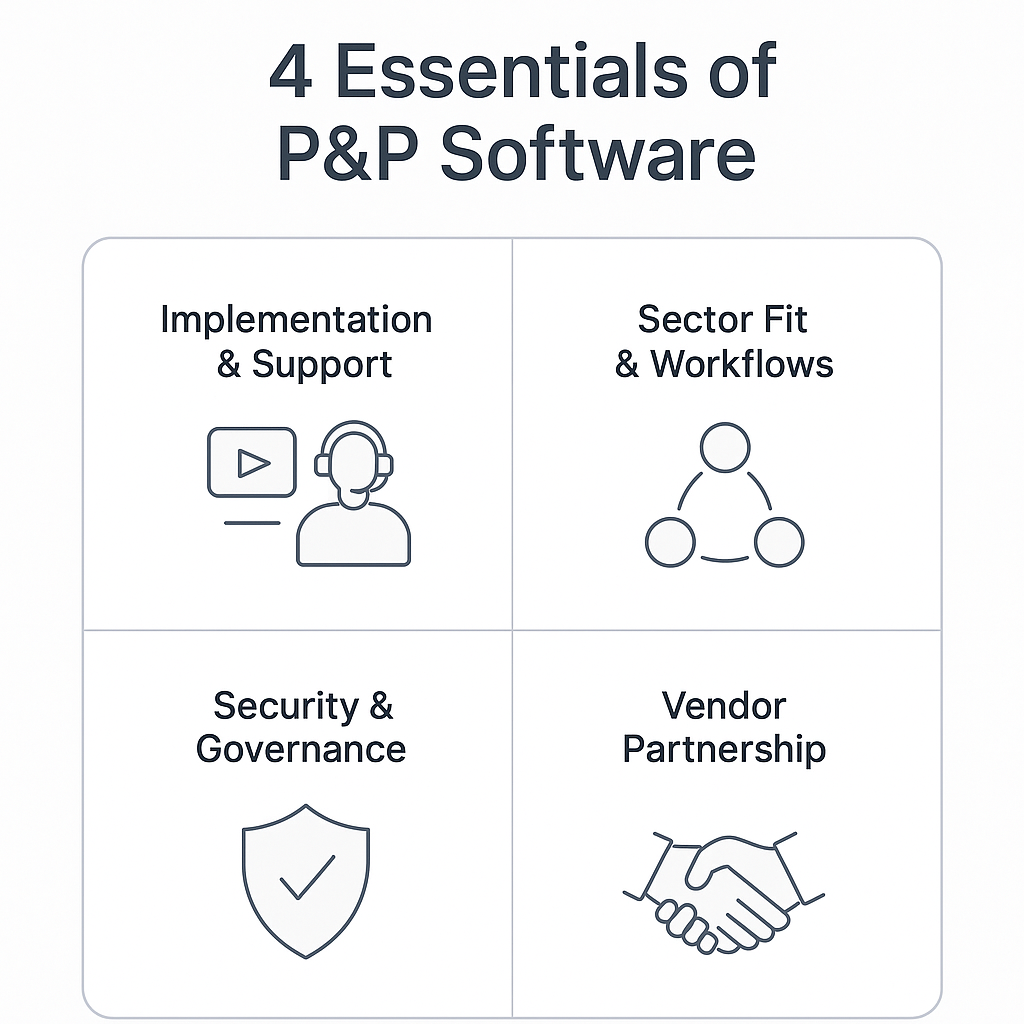
Selecting policy and procedure management software is less about chasing features and more about building a durable foundation for how your organization creates, approves, and communicates its rules. When the four considerations are addressed—support, sector fit, governance and security, and long-term partnership—you reduce the risk of costly missteps. Here at ComplianceBridge, we can proudly assert that we check all of the boxes!
Support: From day one, a dedicated, experienced Client Success Manager will be “hands on” to assist with 1:1 personalized dedicated support. Our clients say that our program of aftersales support and training – including free user training webinars – is second to none.
Sector Fit: From colleges to healthcare to law enforcement, ComplianceBridge has over a decade of experience in helping organizations across the spectrum efficiently manage their compliance requirements. Backed by a staff with broad experience in multiple sectors, our versatile software can be customized specifically for your organization.
Governance: With extensive experience in IT, corporate security, corporate law, and management, ComplianceBridge ensures that your data is secure, that users have access to documents specific to their duties and responsibilities, and that only the latest versions are available. Hosted on secure servers with redundant power, redundant disks, high bandwidth, and SSL security, we perform local daily backups and remote, encrypted, weekly backups.
Long-Term Partnership: Committed to long-term customer relationships, your account manager stays with you from the evaluation stage through the life of our relationship (truly a “business marriage”), meaning that the same individuals are responsible for your success the entire time you partner with ComplianceBridge. With 98% customer satisfaction and 97%+ customer retention, we intend to partner with our clients for the long term.
There’s a lot of fish in the sea, but there’s only one ComplianceBridge. Request a demo of our policy and procedure management software today to see if we are the suitable partner for you!
Request a Demo Today
See our product in action with your own private demo. During the live demo we cover key functionality plus any detail you want. Pick your date and time now, and let us know what is most important to you.