How a policy reaches people shapes what happens next. A policy that arrives without context, explanation, or follow-up tends to get skimmed and forgotten, even if that policy is well-written and much-needed. Policies that arrive with purpose get read, understood, and acted on. This difference comes down to how your company manages policy implementation.
Policy implementation has more of an impact on employee engagement than many organizations realize. When handled well, policy implementation gives employees boundaries. It involves them in decisions that affect their daily work. And it keeps the conversation open after the policy goes live.
Often, policy implementation refers specifically to distributing and enforcing a policy or procedure. But for today, let’s zoom out a little and take a look at how building employee engagement and enthusiasm involves every phase of the policy lifecycle.
Every step, from first draft through review, is a chance to bring employees in. When managed effectively, a routine rollout can translate into real engagement across the entire company.
Core Components of Effective Implementation
No process is beyond improvement. Luckily, policy implementation tends to follow a predictable arc. Each stage offers opportunities to engage employees and strengthen implementation.
Build the Policy Right
Good policy implementation doesn’t start with distribution. It doesn’t even start with drafting that policy. It starts with a question: Is a new policy (or a policy revision) genuinely needed? Writing and implementing a policy that repeats or overlaps with the content of an existing one adds noise and pulls focus.
Then pressure-test that policy, using these questions:
- Does this policy address a specific need or problem?
- Who does this policy govern?
- Who enforces it?
- How is compliance measured?
- What incentive or penalty applies?
- How will success be judged?
When it comes time to actually draft and edit the proposed policy, keep the language simple. Be plain, clear, and concise. State the consequences of noncompliance in terms that anyone can follow.
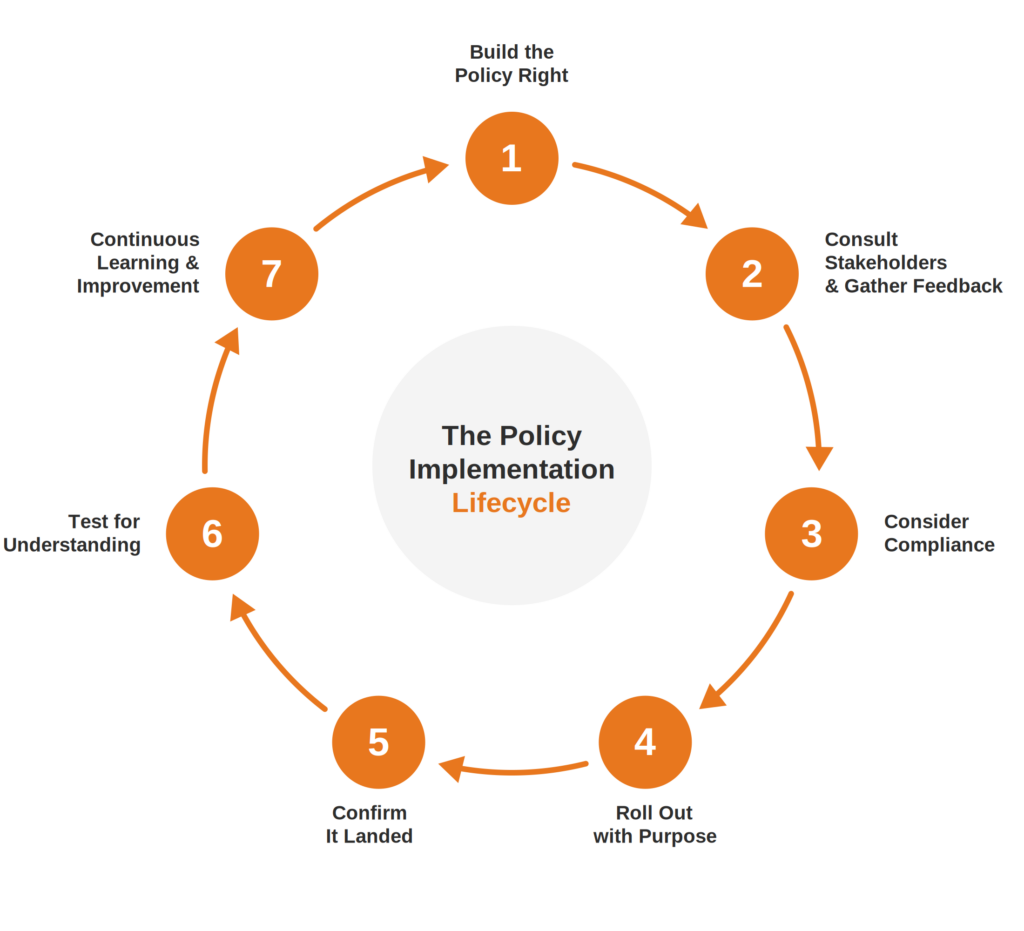
Consult with Stakeholders and Gather Feedback
Stakeholder collaboration strengthens policy implementation. As you define the team who will create, edit and approve the document, widen the feedback loop by encouraging employees and stakeholders to engage in the process.
Subject matter experts, managers and supervisors, employees and employee representatives, and members of HR are all good candidates, as they all have a stake in how a policy reads and how it lands. The people that that policy will actually impact are best positioned to tell you whether it fits the real work environment, and engaging them helps build investment in that policy’s success.
Consider Compliance
What compliance issue or rule does this policy address? What about this policy will motivate individuals to comply? Before you finalize the document and the language in it, test likely reactions or responses with the assembled stakeholders so you can improve the policy while there’s still time to do so.
Once you’ve reached your final draft of the document, decide the scope and significance of that particular policy, and what level of compliance you consider good enough. Then size your rollout and monitoring to match.
Roll out with Purpose
With the policy itself completed, next comes planning for policy distribution and implementation before it goes live. Policy distribution should include as much context as possible; a planned, organized, well-timed rollout will have far greater impact (and secure better compliance) than one that lands without framing or fanfare.
Align the scope of the rollout with the document’s stakes. A new policy regarding workplace electrical hazards may warrant language that uses intense, life-or-death framing, and a full training series for relevant employees. A simple minor administrative update, on the other hand, may only require a short, clear, notice.
Confirm it Landed
Distribution heralds the start of policy implementation, not its end. You still need to confirm that the message reached people, and you need documented confirmation that they understood it.
Attestation usually serves as the first measure. Require the target audience to acknowledge receipt and confirm their understanding.
Many digital tools, including dedicated policy and procedure management software, give organizations the ability to automatically track that attestation in real time, so they can gain a better understanding of where and when follow-up or clarification may be needed.
Reminders and escalation for stragglers then get built into the process, creating a record of acknowledgement and compliance (that doubles as an audit trail).
Test for Understanding
When necessary, next comes comprehension testing or training. Many organizations, especially ones that use policy software, use surveys and tests to gauge policy understanding and to collect input for future revisions. Deploy them alongside the policy and, if necessary, re-test on a one-off or annual basis to confirm retention.
Create a Cycle of Continuous Learning and Improvement
Once the policy has reached its target audience, how will you evaluate its efficacy? You should have a plan in place well before distribution for analyzing whether the policy was followed, whether it worked as intended, and whether it produced any unintended effects.
Allow for the possibility that a policy proves flawed, or doesn’t have the impact you anticipated. Even after release, policies are still living documents.
You may realize two weeks after distributing a policy that it requires some revision. Or, four years after successful policy implementation, regulatory changes in your industry may require updates to a policy to align with those changes.
Many businesses institute regular periods of policy review for this very reason. A willingness to adjust keeps policy implementation credible and compliant over time.
Closing the Gap Between a New Policy and Real Compliance
No matter how hard you work, every policy inherently carries a gap between publication and actual compliance. Effective policy implementation creates a bridge across that gap. The more the organization engages employees in dialogue along the way, the more likely it becomes that that policy will act as a constructive force and not a disruptive one.
That dialogue does real, important work. It surfaces the reasons behind noncompliance – reasons usually rooted in practicality, not deliberate disobedience. An unclear policy that leaves out important information leaves employees unsure of what the policy actually requires of them, and renders compliance nearly impossible to actually achieve. A policy with a high barrier for enforcement makes regular adoption difficult. Unclear expectations leaves room for interpretation, and ends up pulling different teams in different directions.
None of this reasoning will ever show up in a report. These responses come up in constructive conversation, and only when your organization has built the proper channels to make that conversation possible.
Engaged employees speak up. When they feel included in the policy process, they can offer insights that explain why a rule works in one department, and stalls in another. These insights help strengthen policies and performance over time. Every phase of policy implementation should build toward that payoff.
What Does Effective Implementation Look Like?
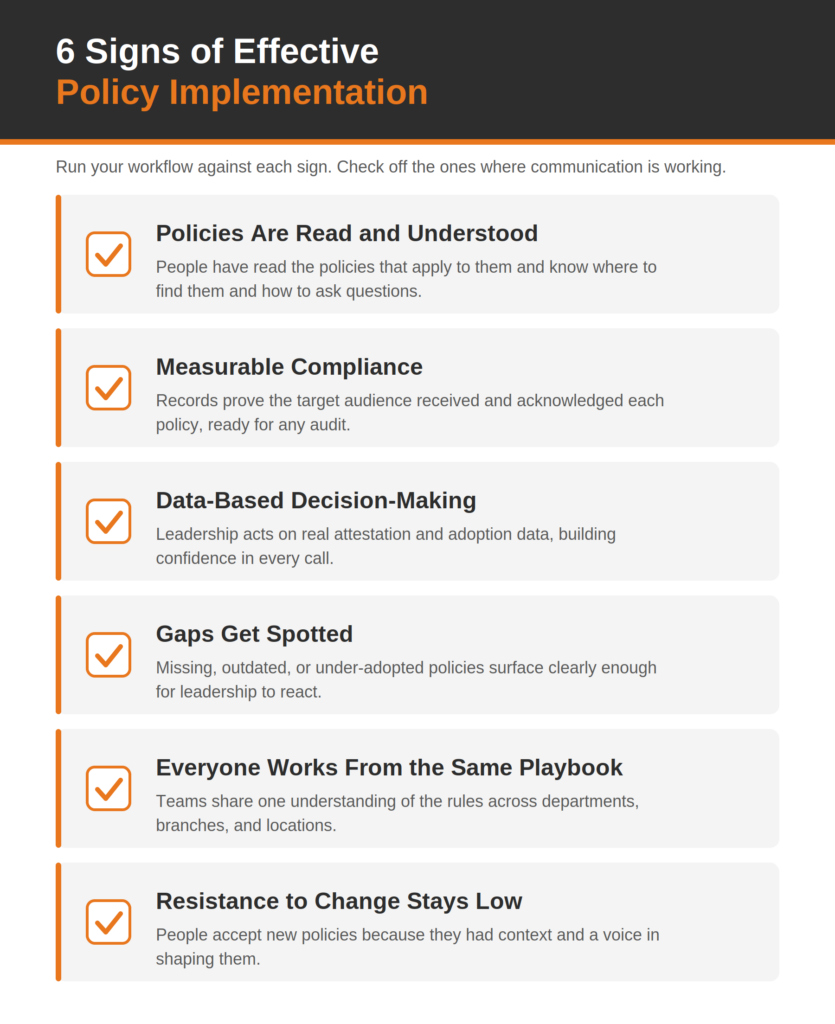
If you want to improve a process, it helps to know what a working one looks like. Here are six common signs that an organization is effectively handling policy implementation.
Policies and Procedures are Read and Understood
People have read the policies that apply to them, and they demonstrably understand those policies. Employees also know where and how to find policies if they need to reference or review them. When workers have a question or a concern about the policy, they know the proper avenues for asking questions or giving feedback.
Measurable Compliance
Records exist showing that the target audience for certain policies read and understood those policies. If a policy is challenged legally, or if an audit occurs, the organization has organized, accessible recordings proving that policy was communicated to and acknowledged.
Data-Based Decision-Making
Nothing gets decided in the dark. Management makes decisions using real, accurate attestation and adoption data, building and securing confidence in those decisions.
Gaps Get Spotted
If a policy is missing, outdated, or lacks the proper levels of compliance, the shortfall shows up clearly enough that leadership can react and adjust accordingly. If conditions change or new stakeholders join the organization, the relevant policies come back around for review and revision.
Everyone Operates From the Same Playbook
Teams share a common understanding of the rules across departments, branches, and locations, limiting policy drift between teams. All employees, regardless of role or leadership status, get held to the same stands regarding policy adherence and compliance.
Resistance to Change Stays Low
People accept new policies readily. They’re given adequate information and context around new, updated, and revised policies, and they know that their perspectives and their voices are represented in every document they receive.
The Common Thread
These six signs follow the same pattern; communication and visibility. Policies that are read, evidenced, reviewed, and accepted are policies people can see, understand, offer and seek feedback on, and respond to.
When policy implementation does break down, it usually breaks down at one of these points. The message never reached the right people, or it reached them without the context that would have made that policy stick.
This pattern also serves as a practical test. Within your own organization, run your policy implementation workflow against these signs. The ones you recognize and can check off are the places where communication is working. The signs that you don’t see evidenced within your organization (yet) are the parts of policy implementation that require the most attention.
Manage, Create, and Distribute Policies Effectively with ComplianceBridge
Employee engagement grows directly out of how your business handles policy implementation. Build a policy with input and feedback from the people that policy governs, distribute it with context, confirm it was understood and received, and evaluate the response, and you create openings for engagement at every phase.
That engagement compounds over time. A policy people have a hand in shaping is one they’re more likely to follow. A rollout process that describes itself meets less resistance. A cycle of review that openly encourages feedback turns compliance into an ongoing, productive dialogue. And the end result is an organization with policies that are read, understood, and trusted, and with employees who perform better because they’re involved in that process.
That work stays sustainable with the right system to support it. ComplianceBridge’s Policy and Procedure Management software provides businesses with that system. The software automates every step from drafting through policy implementation, offering avenues for productive engagement and collaboration along the way.
Stakeholders across an institution can work together on a single, central policy document with clear ownership and version controls, encouraging collaboration without creating confusion.
Those stakeholders can build and reuse review workflows that move policies through approval. Once approved, distributing policies to the people who need to receive them is as simple as pressing a button. The system then allows you to track acknowledgment and, when necessary, gauge employee understanding with customizable quizzes.
Automated reminders, review dates, and expiration dates keep people and policies from slipping unnoticed through the cracks. The dashboard also generates metrics based on responses in real time, with the option of generating reports for further analysis and review.
Schedule a demo with ComplianceBridge today to learn more about how our tools can strengthen policy implementation across your organization.
Guide to Managing Policies Written in Word and Other Formats
In this ebook, we break down 10 core principles for maintaining control and efficiency when managing policies written in Word and other formats. Following these principles can help you ensure strong policy management in your organization.