Organizational conflict of interest training is one of the most important (and most underutilized) tools a business has for protecting its integrity. Conflicts of interest arise when an individual brings outside relationships, financial stakes, or personal associations into their professional obligations (or appears to do so).
These conflicts, if left unnoticed, unnegotiated and unchecked, could affect the performance or decisions of the entire organization. Biased decision-making at the individual level can ripple outward to adversely impact performance, finances, and reputation in ways that are difficult and expensive to reverse. In serious cases, the legal repercussions can get significant.
Luckily, there are ways to make sure potential conflicts of interest held by your company’s employees don’t snowball all the way into serious moral or ethical dilemmas for your organization. Targeted, dedicated training can empower your employees and stakeholders to recognize and appropriately address potential workplace conflicts of interest, protecting the company’s ethical and financial integrity.
When employees understand what conflicts of interest look like, how to recognize them, and what to do when one arises, the organization as a whole becomes more transparent, more accountable, and less vulnerable to the kind of unchecked bias that causes real damage.
In this article, we’ll discuss what effective organizational conflict of interest training requires, what methods work best, and how to build a program that holds up over time.
Core Components Every Training Program Needs
There are many different ways to implement organizational conflict of interest training within your business (and we’ll get to those in a moment!) but here are some core components that help determine whether any program, regardless of format, actually works.
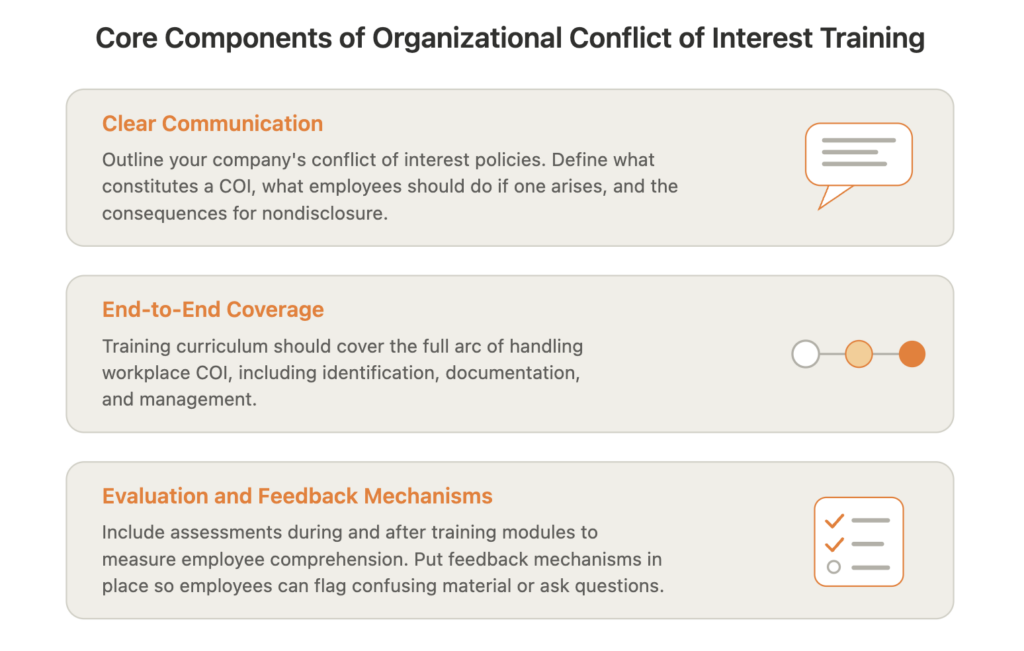
Clear Communication of Policies
Effective organizational conflict of interest training must start with a clear, plain-language explanation of information in your organization’s conflict of interest policies (and we don’t just mean the legal language). Begin by clearly defining what constitutes a conflict of interest, what an employee should do when one arises, and the consequences for non-disclosure. If employees in different departments and at every level of the organization can’t follow the content, the training has failed before it’s even gotten off the ground.
End-to-End Coverage
Your organizational conflict of interest training curriculum should cover the full arc of handling COI, including identification, documentation, and management. Employees should leave training knowing not only what workplace COI is, but the different types of conflict (financial, personal, informational, and so on) and what to do when one arises.
What does the conflict of interest disclosure process look like for your company? Is it annual? Biannual? Do you have an ad hoc disclosure process for when potential conflicts crop up outside the usual disclosure cycle? Comprehensive organizational conflict of interest training needs to answer all of these questions.
Evaluation and Feedback Mechanisms
Include assessments during and after all organizational conflict of interest training programs or modules. For these programs to work, it’s helpful to have a way to measure whether or not employees actually understand what they’re supposed to be learning. Feedback mechanisms that give workers a chance to flag confusing material or ask questions strengthens the program over time.
Best Methods for Delivering Navigational Conflict of Interest Training
The question here isn’t whether your organization should train employees on COI, it’s how to do so in a way that actually reaches people. There are many ways to learn, and just as many to teach. The method you do use should cater to different learning styles while staying compatible with your organization’s logistical needs.
Dare to be Digital
In-person training sessions can help encourage discussion and allow for immediate feedback. However, physical organizational conflict of interest training sessions aren’t always the most practical option, especially for bigger companies, or ones that have a large number of remote and/or international employees.
That’s why many organizations opt for online training or e-learning modules. Online training modules can be distributed instantly and consistently to an entire workforce, regardless of their physical location. Many businesses use automated conflict of interest software for this reason.
Good COI software goes well beyond just hosting a video or PDF. It allows management and supervisors to build customizable questionnaires and other learning materials, and distribute them to everyone, or just across specific roles and departments. Completion gets tracked in real time, and the system flags employees who haven’t participated so managers can follow up.
Automated COI software saves all employee responses in a centralized database – meaning nothing gets lost, misplaced, or conveniently forgotten. That centralized record becomes a valuable asset over time; Response data can be analyzed to identify patterns, potential risk areas, or inform improvements to training over time.
Keep it Customizable
The best and most effective conflict of interest training programs are tailored to the specific risks and operational realities of the business (and industry) in question. Generic training may satisfy a compliance requirement on paper, but it’s less likely to resonate with employees or prepare them for the types of COI they’re most likely to encounter on the job.
Meaningful customization requires meaningful collaboration between department heads and supervisors to create tailored content that aligns with the day-to-day experiences of employees.
Don’t Overcomplicate It
When it comes to organizational conflict of interest training, simplicity is key. Complex jargon or overly technical language can alienate employees, making the training less effective. Use clear, accessible language that resonates with employees across various departments and levels of expertise. This approach not only ensures that the content is understandable but also helps in maintaining the interest of the workforce throughout the training.
Implementing and Sustaining a Training Program Over Time
Launching an organizational conflict of interest training program isn’t the same thing as sustaining one. Once you’ve rolled out your training, the actual work begins.
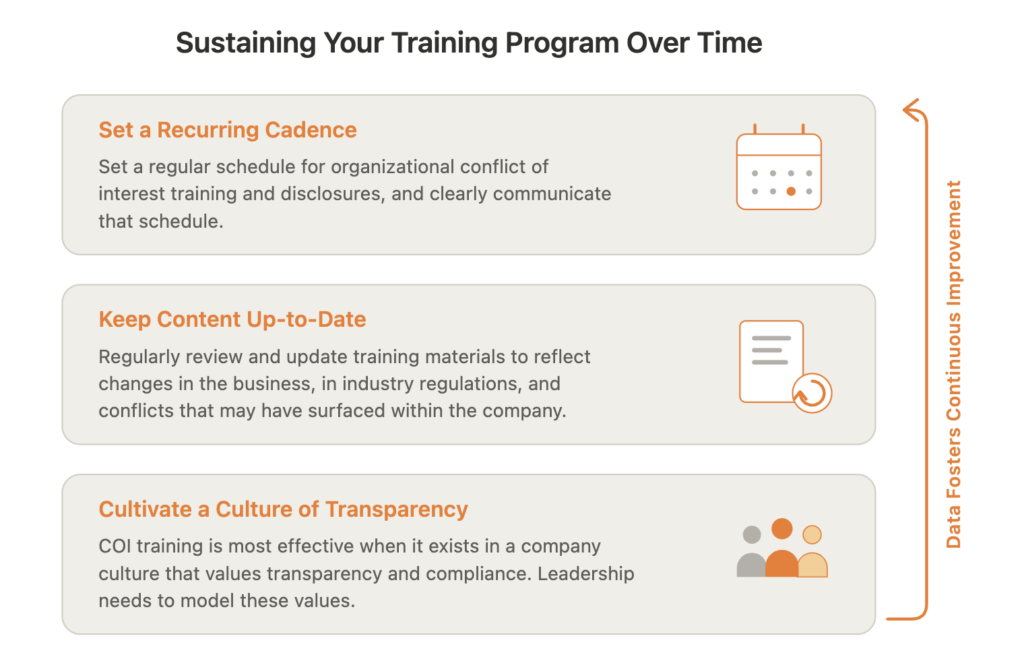
Set a Recurring Training Cadence
Conflict of interest disclosure isn’t a one-time event, so don’t treat it like one! Employees’ circumstances always run the risk of changing in ways that can create conflicts, whether they be new outside employment, financial changes, or personal associations with vendors or colleagues. A COI training program that runs once at onboarding and then never gets brought up again won’t be able to meaningfully address this.
It’s a better idea in the long run to set a regular schedule for organizational conflict of interest training and disclosures – then clearly communicate that schedule. Software solutions for COI training and disclosure can automate reminders and notifications, keeping things moving without requiring someone to handle it all manually.
Keep Content Up-To-Date
Regularly review and update training materials to reflect changes in the business, industry regulations, and common types of conflicts that may have surfaced within the organization. If employees sense that the training hasn’t been updated in years, they’re less likely to take it seriously, or actually apply it.
Cultivate a Culture of Transparency
How does your company as a whole view compliance? What about transparency? Organizational conflict of interest training is most effective when it exists within a company culture that genuinely values transparency, and doesn’t treat it like just another legal obligation.
This is where the leadership within an organization really comes into play. When managers and supervisors model appropriate disclosure behavior and engage with training seriously and visibly, it signals to everyone else that conflicts of interest are a real concern worth taking seriously. It also signals that no one, regardless of role or rank, is above the rules when it comes to the risks presented by conflicts of interest.
Data Fosters Continuous Improvement
Here’s another area where conflict of interest disclosure software comes in handy! Organizations that use digital training solutions have access to response data that manual methods can’t produce. Which questions do employees consistently get wrong? Which departments have lower completion rates? This data should be routinely analyzed and used to refine training content and identify risk areas that deserve closer attention.
Manage Conflict of Interest with ComplianceBridge
Strong, effective conflict of interest and risk management begins with organizational conflict of interest training. And effective training begins with the right tools. Let ComplianceBridge provide those tools for your organization. Our conflict of interest disclosure software gives businesses everything they need to manage COI disclosure at every stage.
Use the system to design assessments that fit the needs and structure of your organization, whether for ad hoc conflict of interest disclosures or as part of a regular process. Choose from multiple choice, yes/no, fill-in-the-blank, ratings, or open-test response formations. You can also weight questions by importance, add conditional follow-up questions, and monitor submissions so nothing gets missed.
Once those submissions are in, responses get displayed in real time, making it easy to identify trends in responses and spot areas that may require further attention. With our reporting and analytics dashboard, businesses can take collected data and use it to generate reports for presentation or further analysis.
If you’re ready to tackle organizational conflict of interest training and disclosure in the best way for your business, request a demo today to see for yourself how ComplianceBridge can help you make that happen.