There are over 4,000 institutions of higher learning in the United States, and probably just as many different approaches to higher education policy and procedure management. Colleges and universities are oft-celebrated for their long-standing traditions, their unique governing structures, and the protected environment they’ve historically enjoyed.
Today’s reality of instant news, social media access, and vocal constituencies have irrevocably changed that picture. When something goes wrong on campus, the response is often an immediate and public one. That puts higher education policy used by these institutions under a spotlight they weren’t built to withstand.
Increased scrutiny has led colleges and universities to rethink – well, a lot of things, but one in particular: how they create, coordinate, and manage their policies and procedures. When incidents surface, whether they pertain to sexual assault, drug use, athletics, or admissions, the first thing exposed is often a missing higher education policy, or an unclear policy, or a policy that responsible parties failed to follow or enforce.
The organizations that can weather those moments are the ones that treat higher education policy and procedure management as an ongoing discipline, instead of an 8 p.m. dorm fire drill. In this article, we’ll discuss best practices for managing higher education policy, from creation through when that policy goes into effect.
Stop Managing Higher Education Policy Reactively
A well-worn observation in the home security industry states that most people order an alarm system the day after a break-in. Colleges and universities tend to follow the same pattern. After a serious campus incident, a predictable sequence follows of expressions of rage and regret, and a pledge by the institution to review current policy so whatever happened never happens again.
By the time that review completes, the damage has already been done. The rushed fix that follows often leaves an opening for new problems.
This reactive cycle is a terrible fit for the actual environments in which institutions of higher education operate. Over the last decade, massive social and technological changes have swept through campuses like wildfire. Topics like race, alcohol, drugs, income equality, and social justice create waves of change that still challenge many institutions. The truth is that administrators can’t afford to simply respond after the fact.
Shared governance raises these stakes even further. The spirit of broad participation that defines higher education is an obvious strength, but it also necessitates that more people get involved in every higher education policy decision. A higher volume of decision-makers increases the (already very real) need for strict, well-controlled management systems. When binge drinking, preferential treatment for athletes, or ambiguous admissions practices make headlines, falling back on “there was no policy in place,” or “the policy was unclear,” or “the people responsible for this policy violated it” barely registers as a real defense.
A proactive approach to higher education policy replaces that scramble with defined systems and processes that make policy management more efficient and more effective.That proactive approach is defined by five characteristics:
- Centralized, automated creation, deployment, and maintenance. Documents stay current, updates reach who they need to reach, and an audit trail preserves policy history and records over time.
- Strong cross-organizational review. Coordinated review across departments fends off conflicting or inconsistent policies, and keeps shared governance intact.
- Distribution that requires acknowledgement. Acknowledgement turns a published document into a tracked, enforceable expectation.
- Optional testing. Testing confirms that a policy was genuinely reviewed rather than clicked through and forgotten.
- Targeted distribution by group and role. Sending policies to the people they actually affect increases compliance and spares everyone else from a mass release of every policy at once.
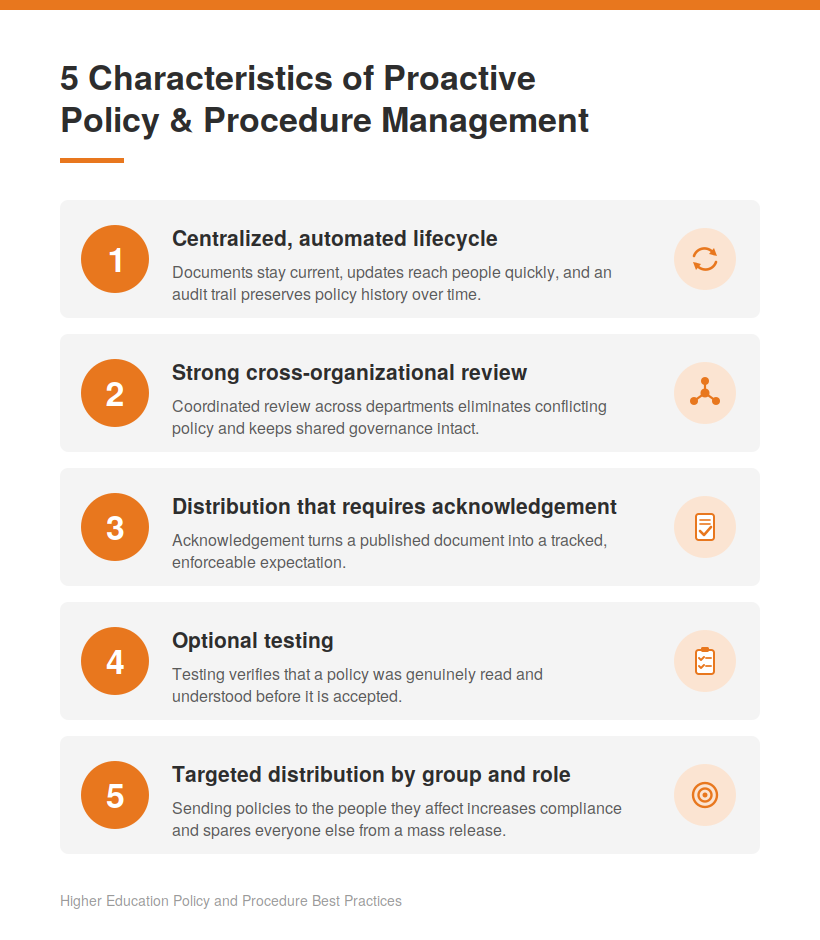
These five things (some of which we’ll revisit later) form the foundation for everything that follows.
Build a Structured Creation Process with Clear Roles
A proactive mindset can only do so much without an actual process in place to support it. The policy creation process at colleges and universities is notoriously complex, and for good reason. Creating a new policy, or significantly updating an existing one, means navigating workflows with diverse groups of stakeholders and several feedback loops.
On its own, a single workflow might be manageable, but the typical policy library spans several policy domains, each with its own requirements. Once you add the pressure of rising regulatory demands against flat or declining funding, the case for a deliberate, well-defined structure gets pretty hard to ignore.
The foundation of that structure rests on clearly defining who does what. Most institutions adept at managing higher education policy take the time upfront to outline roles and responsibilities, which may vary in specifics, but typically include:
- Primary policy contacts. They view and approve final policy drafts for specific policy areas. They also propose new policies, or work with the policy office to write them.
- A policy office. This office develops and maintains processes for administering policies, safeguards accuracy, and communicates approved policies to the people who need to follow them.
- Policy coordinators. These individuals serve as a policy resource to anyone proposing policy. They assist with policy development, route and coordinate copies of draft policy, and assist with dissemination. They also participate in post-approval policy management including maintaining a policy masterlist, maintaining approved copies of each policy, and containing supplementary materials for the development of each new policy and procedure.
- A policy review committee. When necessary, committee members review higher education policy drafts and make recommendations to policy coordinators on readability, consistency, and format.
With roles defined, templates and a shared policy framework add the next layer of structure. Templates keep policies looking consistent and professional, but beyond that, they make rollout much faster, especially in an emergency where the basic scaffolding of a higher education policy needs to be ready to go on short notice.
Every policy moves through the same lifecycle, which looks something like this:
- Development. This stage starts with identifying a need. Maybe a university has just launched a new applied learning program, and that program requires policies around eligibility, supervision, and student responsibilities. With that need established, next comes research. Possible issues and possible solutions get investigated, experts are consulted, and language is drafted.
- Review. This stage supports one or more periods of comment for relevant stakeholders and team members, followed by several levels of formal review. Who does that reviewing will differ depending on the content of the higher education policy; A gifts and donations policy, for example, will require reviewers with different expertise than those for an IT security policy.
- Approval and Publishing. After clearing the appropriate channels, which may include a policy committee, the dean, the provost, the president, or the board of trustees, the approved policy returns to the policy office to be distributed to the library.
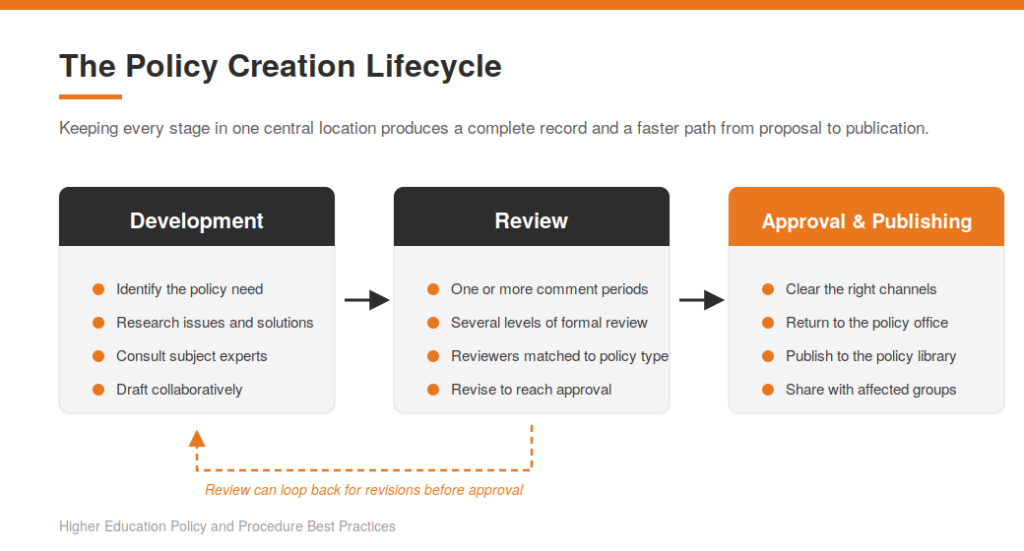
The best practice tying these stages together is to keep all of them in one central location. When development, review, approval, and publishing live in a single system, the institution gets a complete record of its policy efforts and a faster path from proposal to publication.
Strengthen Distribution, Acknowledgement, and Accessibility
A well-written, well-crafted policy that no one reads, let alone follows, does nothing to protect an institution. Our final set of best practices covers what happens after approval: getting policies in front of the right people, confirming they were received and understood, and keeping those documents easy to find.
Acknowledgement and accessibility are what turn a published document into an enforceable standard. This is where a proactive higher education policy program, backed with the right tools such as policy management software, really proves its value.
Require Acknowledgement and Confirm Comprehension
A higher education policy that requires no acknowledgement is an inherently weak one. When students, faculty, and staff are required to confirm they have received and read a policy, the institution can move from hoping people are informed to knowing they are – and it has the record to prove it. For the policies where comprehension matters most, comprehension testing adds another layer that verifies a policy was genuinely reviewed, not just clicked through.
Distribute by Group and Role
The way institutions of higher education distribute policies matter just as much as acknowledgement does. Using targeted distribution to roll out policies to specific groups or roles helps safeguard compliance. It also keeps those unaffected by certain policies from getting buried under notifications about a document that doesn’t even pertain to them.
Releasing the entire policy library onto a single public page may feel more inclusive than targeted distribution, but in practice it seriously complicates enforcement, as there’s no real way to confirm who saw what. Dispensing each policy to the specific groups it actually governs keeps the distribution and acknowledgement trail clear and trackable.
Make Policies Easy to Access
Accessibility is everything! Higher education has long struggled with the gap between approving a policy and getting it in front of people. This bottleneck has a tendency to delay policy efforts, especially in moments where speed really matters. This problem is a pretty serious one, because many higher education policies need to reach a wide audience, including current and prospective students, faculty, staff, donors, and members of the public.
One way to close this gap is by using a public web portal that keeps policies available at all times, in a format that looks consistent with the institution’s main website. Visitors can move from the marketing pages to the policy portal seamlessly.
Connect Distribution to Compliance and Institutional Goals
Strong distribution practices help with enforcement of individual policies, but they’re also how colleges and universities meet compliance obligations at scale. Institutions of higher learning have to satisfy their own rules, the rules of any larger system they belong to, and a wide range of local, state, and federal regulations.
Acknowledgement and accessibility are how an institution demonstrates, policy by policy, that the right people received the right information and that all requirements were met. These same practices support both campus safety and student success, as both depend on the affected groups understanding and following the policies intended to protect and guide them.
Manage Higher Education Policy with ComplianceBridge
For today’s colleges and universities, higher education policy carries stakes too high to manage haphazardly. The institutions that manage policy well are the ones that treat it as an ongoing discipline. They anticipate change before it arrives, build a creation process with clearly defined roles, and they back every policy with acknowledgement, verified comprehension, and easy access.
Managed this way, higher education policy becomes the cornerstone of the shared governance framework on which higher education runs. It makes compliance provable and campus safety and student success achievable. And a software platform built to manage the policy lifecycle makes this level of discipline practical at scale.
Let ComplianceBridge be that platform for your institution! Our policy management software automates everything from policy creation to rollout. Stakeholders across an institution can collaborate on a single policy draft, build and reuse review workflows that move policies through approval generating labyrinthine email chains. Once approved, those policies can be published to a branded portal in one click.
If you’re ready to stop managing policy reactively and start putting these best practices to work, contact ComplianceBridge for a demo today!