In an ever-advancing business world, the days of paper and file cabinets have become as archaic as Hotmail and dial-up modems. In just a few decades, the way your organization operated has likely gone the way of the dinosaurs. That’s just the way of the world. In the name of progress, it might also be time to implement a policy management program within your organization.
A policy management system represents more to your organization than just document storage. Instead, when we talk about a policy management program, we’re describing the structured system companies use to manage expectations, maintain compliance, and operate consistently.
As organizations grow and expand, their policies and procedures tend in turn to become increasingly complex. This is by no means a bad thing—policies and procedures should scale as a company does—but it does mean that informal or manual means of managing those policies won’t be sustainable. Industry scrutiny, workforce distribution, and audit demands require centralized oversight and accountability for those policies, or else run the risk of getting into financial, regulatory, or even legal trouble.
In this article, we’ll delve further into how an effective policy management system can ensure that company policies are accessible, acknowledged, and defensible. We’ll also discuss features to look for, and how the right software solution can help. Let’s get started!
Understanding the Scope of a Policy Management Program
Your business’s policy management program should cover the full lifecycle of policies and procedures within your organization, and we do mean the full lifecycle. Your program should be in use during the initial drafting process to help organize information, incorporate subject matter expertise, and seek input from relevant stakeholders across departments and divisions. That program should also provide a structure for formal approval of created policies, especially if legal or executive oversight is required.
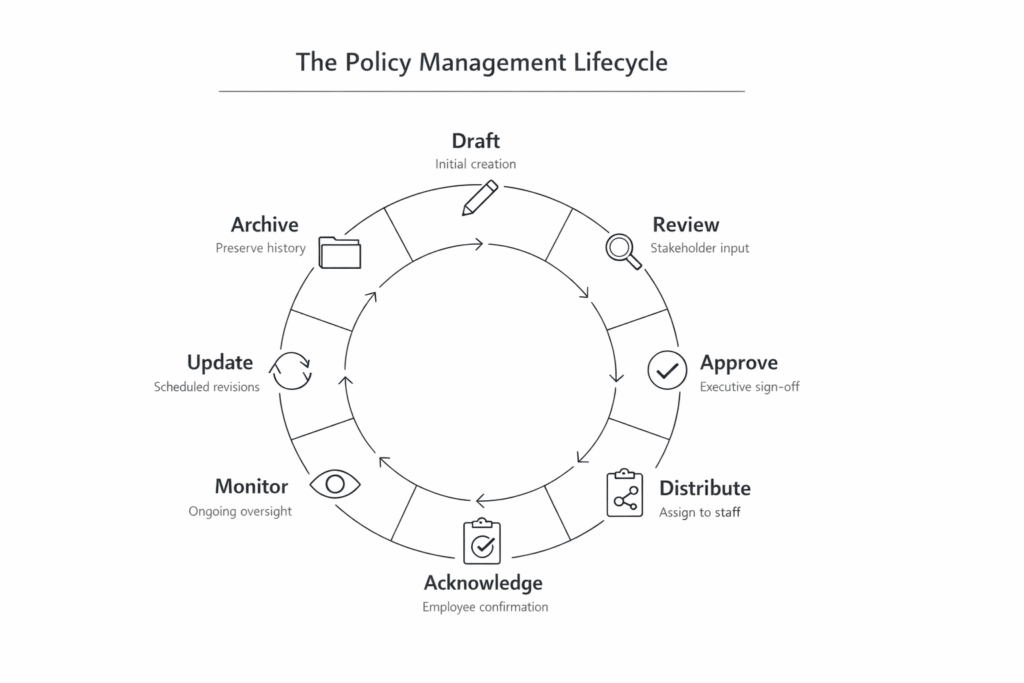
Once policies are created and distributed, the policy lifecycle doesn’t stop, and neither should your company’s program. There should be a system for scheduling review reminders so policies don’t become outdated, and for maintaining records of retired or archived policies without cluttering active repositories. Crucially, every action dictated by your policy program should be documented in some way, as having detailed policy lifecycle records provides defensibility in the event of possible legal trouble, regulatory trouble, or an audit.
What Your Program Should Include
Accessibility Through Centralization
It’s hard – nigh impossible, even – for an employee to follow a rule if they don’t know what it is. Likewise, it’s difficult to measure policy and procedure compliance when employees aren’t clear on what they’re supposed to be complying with. The ideal policy management program should include an easy way for employees to retrieve and review relevant policies or procedures.
A great way to ensure greater accessibility? Centralization! Prioritize a program that utilizes a single, authoritative system for housing policies, instead of letting important documents stay scattered across shared drives or email threads. Centralization reduces duplication, outdated documents, and conflicting guidance around policies and procedures. Storing all policies in a centralized, digital location also gives employees searchable access to those documents, so they can always locate relevant policies quickly.
Version Controls
A common policy management mistake is having multiple versions of a single policy or procedure in existence. Whether a policy is still being drafted or has been published and available to employees for years, it’s vital that you and everyone in your organization understand which version is the most current.
Your policy management system should include a way to ensure that only the most current version of policies are available for the end user. This will keep employees from accidentally referencing outdated documents, instead of the more current and correct version. To that end, policy and procedure managers should have the ability to update and replace older versions of the policy.
Each revision of a policy should be tracked and preserved as well. While archiving outdated versions of policies might not be as useful in the short term, it’s a good idea to have the entire history of every policy available for future reference, or to help prove an audit trail.
Distribution
Policy distribution is an oft-overlooked element of a successful compliance management system. How your organization delivers documents to employees can have a long-reaching impact on issues associated with policy management such as audits, compliance and costs.
When structuring your company’s program, don’t let distribution fall by the wayside! Look for tools that can help keep this process from getting too chaotic. Essential features to look for in a policy management program include the ability to establish a distribution mechanism that ensures the correct people receive the correct policies. It should also be able to create groups to differentiate which members of your organization receive policies, procedures, training manuals, and all other documents critical to the operation of your business.
Tracking
If you want your program to be successful, you can’t just set controls or create policies and then leave them. Your system should include regular audits of policies, procedures, and other controls to ensure that these mechanisms continue to function smoothly. Compliance tracking tools are a good way for a policy management program to monitor that everything is working as intended. These tools track and ensure that end users have received, tested comprehension, and signed off on policies. They can also help in the creation and scheduling of audits.
Reporting Tools
Ultimately, the power of the program your business utilizes will stem from its reporting capabilities. Visibility is a crucial component of policy management, and the solution you choose should have the proper reporting tools to safeguard that visibility. Your organization needs to be able to create and run reports on question sets, so management can analyze data for insights into things like acknowledgement rates, overdue reviews, and policy gaps. Data visibility also helps compliance teams identify trends and risk exposure, strengthening your business’s regulatory compliance.
Where Policy Management Commonly Fails
A policy management program isn’t exactly a new concept. Most businesses have a system (hopefully) for creating, enforcing, distributing, and storing company policies and procedures. But those systems often lack the organization and efficiency that a program requires to actually work. Be on the lookout for these red flags:
Inconsistency
A policy management system that relies heavily on email-based approvals, or document sharing during policy creation, is one that’s all-too-likely to get your organization in trouble. Using email creates scattered, inconsistent documentation, and makes it too easy for things to get missed or slip through the cracks. Likewise, using a shared drive leads to version confusion and unauthorized edits. Neither your email or your Google Drive account were created for policy management or distribution, so why use them that way?
No Ownership Controls
Each company policy should have an assigned owner, responsible for the contents and review of that policy. Without those controls in place, it becomes easy for policies to become outdated or abandoned without anyone noticing. Without clear governance of policy documents, there is less accountability for or oversight of those documents.
Manual Processes
The same way that email and shared documents fall short as policy management tools, manual tracking for those policies isn’t going to cut it, either. It’s important that all employees receive and acknowledge company policies, but tracking those acknowledgements manually comes with a high risk of error, and increased administrative burden. There has to be a better way, right?
Modernizing Policy Management
If your business still relies on manual policy management methods, it might be time to join the rest of us living in the 21st century and embrace what automation and digitization can bring to your policy management program. Digital policy management solutions centralize and streamline the policy review and approval lifecycle. Centralized systems control who can view, edit, or approve documents, reducing confusion and unauthorized changes. Automation reinforces that clarity by creating a consistent workflow that will keep important documents from getting stuck in email threads or missed altogether.
Automation also gives businesses a high level of customization, so that you can change your workflow as necessary to meet the needs of your business as it grows and evolves. Digital audit trails automatically take note of document changes, approvals, and acknowledgements, creating defensible records. Can your filing cabinet do that?

ComplianceBridge’s Policy Management Does It All
Implementing the perfect policy management system to fit the unique needs of your organization may sound like a daunting task, but it doesn’t have to be. ComplianceBridge’s policy management software is designed specifically for your ease of use, streamlining everything from policy creation to distribution and beyond.
Our automated workflows empower seamless management over policy creation, revision, approval, and distribution. That includes built-in review dates, expiration dates, and reminders to ensure nothing ever gets missed. ComplianceBridge also makes collaboration easy, with multiple stakeholders able to refine policies in a single document with clear ownership and version controls.
Once a policy is finalized, distribution is as simple as pressing a button. The system then allows you to track acknowledgment, test employee understanding with customizable quizzes, and analyze real-time compliance data with advanced metrics and reporting.
Our software has everything you need to optimize your organization’s policy lifecycle — and then some. Contact ComplianceBridge for a demo today to see for yourself what your policy management program can look like with the right tools and technology.