It’s just common sense: Every business should have a conflict of interest management system in place to protect itself and its brand image. Clear, consistently enforced policies regarding conflicts of interest also do a lot of work to help your business avoid trouble with clients, legal penalties, and bad press. But without the proper framework in place to support those policies, your business could run up against conflict of interest management issues such as the mishandling of workplace COI, and ensuing employee dissatisfaction.
Conflict-related risk isn’t limited to large businesses. Even smaller organizations can (and do!) face conflicts like vendor relationships, hiring decisions, gift scenarios, and other situations that may create gray areas. A conflict of interest management system helps businesses protect decision integrity, reduce risk, and strengthen trust with employees, customers, and business partners. A system for managing COI also helps reduce instances of informal “case-by-case” decision-making that can often feel unfair or consistent to employees.
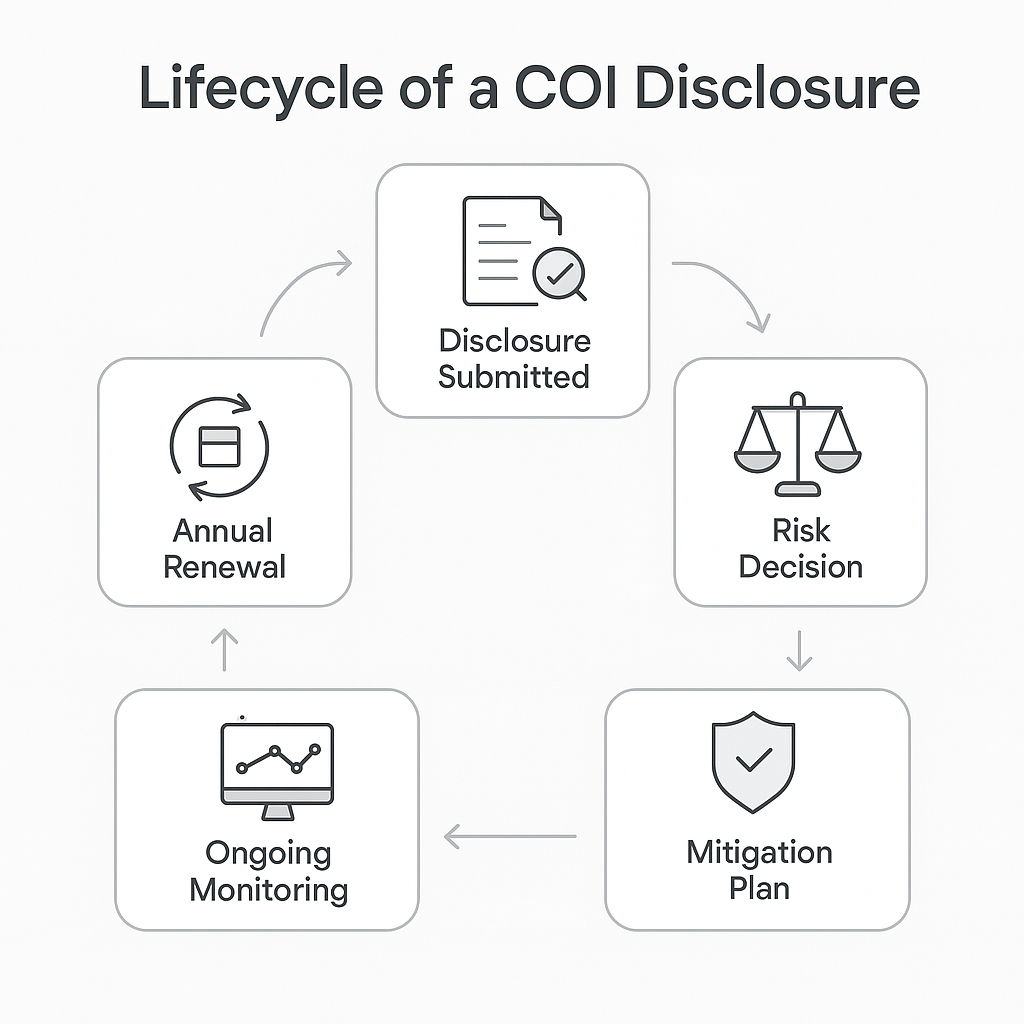
In this article, we’ll break down five tips to help you make an effective conflict of interest management system for your business.
1: Keep it Simple
A conflict of interest management system can be as simple or as complicated as you make it, but we recommend that you avoid the latter as much as possible. Creating a conflict of interest management system that is too complicated will create confusion, and might deter workers from using the system altogether. If your employees are required to fill out an overly lengthy and complex conflict of interest form, for example, they may simply opt not to bother with it at all.
Your conflict of interest management system should be kept simple to encourage more people to use it. When we say “Keep it simple,” however, we’re not suggesting that your conflict of interest management system be too basic, either. Instead, embrace simplicity by ensuring that you have all the necessary information on hand and that the process is straightforward and easy to understand.
A conflict of interest management system has a higher adoption rate when the process of disclosure is straightforward and easy to complete. If the form is easily accessible and filling it out doesn’t feel like a legal exam, workers will be more likely to report early, and report honestly. A simple, straightforward approach improves data quality, because employees are less likely to provide vague answers to clear and purposeful questions.
The right level of simplicity in a conflict of interest management system balances speed with clarity. After employees use it to disclose COI, the compliance team should receive enough context to be able to assess risk without having to chase follow-up emails for basic details. Simplicity also helps promote scalability! Adding new departments, regions, or business units to an existing system is easier when the core processes of that system are clean and consistent.
2: Build the System to Avoid Bottlenecks
All too often, companies lack a streamlined process for managing conflicts of interest, leading to one of the most aggravating final bosses of business: bottlenecks. Bottlenecks are the bane of any organization, and they can be especially harmful when it comes to managing COI.
Many conflict of interest management systems stall and processes pile up when the review workflow depends on one key person, one department, or a single high-level approver. If one person is responsible for handling all workplace conflicts and they find themself unable to do their job due to a lack of resources or time, you’ve got yourself a bottleneck. Having a single-lane review structure increases the likelihood of bottlenecks and backlogs, which will slow decision-making to a crawl during high-volume periods.
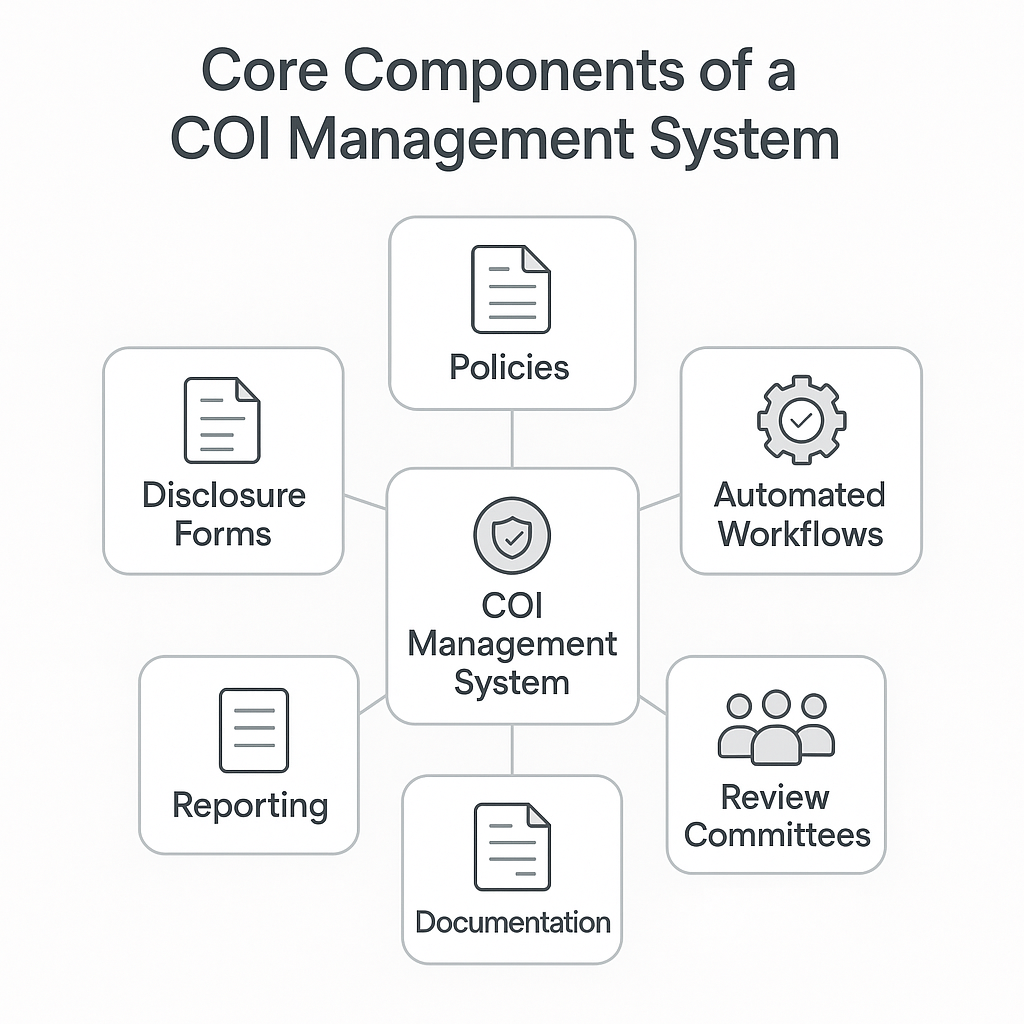
Having redundancies in your conflict of interest management system can help you avoid bottlenecks and ensure that the entire process doesn’t get stuck in one person’s inbox. Instead, multiple people should be involved, so that no one person has to be responsible for verifying that conflicts are managed effectively. This may entail using a system with distributed ownership, and assigning delegated reviewers who follow a uniform framework for decision-making. Clear rules regarding escalation can also help guarantee that higher-risk cases are reviewed at the appropriate leadership level, without requiring that every routine disclosure get dragged into executive review.
Another simple way to avoid bottlenecks in the disclosure process is by using systems that can send automatic reminders to the stakeholders involved. Notifications and structured queues give employees clear expectations about when and how to respond. They reduce administrative strain and the need for manual tracking.
3: Make Transparency a Core Feature
Visibility is a vital component of a successful conflict of interest management system. Making the process transparent improves trust by giving workers visibility into how disclosures are evaluated, and how the outcomes of those disclosures typically look. When they know exactly what’s happening and why, employees won’t be suspicious, or feel the need to keep secrets from each other or from management.
To facilitate this transparency, make sure that all employees are aware of company policies around COI, trained on them, and know how to comply. They should also know what will happen as a result of failing to comply with workplace COI regulations (such as termination, or some other disciplinary action).
Additionally, make this information accessible to all employees. When training employees about COI management and disclosure, define what constitutes conflict in plain, business-appropriate language. Be sure as well to offer practical examples relevant to your industry. This will aid in reducing grey-area confusion around gifts, secondary employment, family relationships, and other common vectors for conflicts of interest.
Another massive benefit of transparent COI management is that employees will feel safer reporting and reporting early. Having increased visibility into what COI management actually entails will allow them to see that conflicts or potential conflicts, once disclosed, are manageable, not automatically punishable.
4: Keep Things Consistent
As you set up your conflict of interest management system, don’t forget that consistency is key! An inconsistent conflict of interest management system creates confusion, wastes everybody’s time, and increases the odds that somebody will break a rule simply because they don’t know what the rules are.
You and your team need to be consistent with how you address COI, both on an individual and a business level. A conflict of interest management system loses all credibility when similar cases are handled differently across teams, locations, or seniority levels. Inconsistent outcomes will create (justified) skepticism in your employees, and increase the risk of underreporting.
Consistent application of a conflict of interest management system supports fairness and defensibility. No one should be above the rules, and procedures for managing COI should show that decisions will always follow the same criteria, regardless of who is involved. Systems with standardized review categories, risk tiers, and resolution options will help reduce subjective decision drift, and make the system easier to scale. These systems also improve reporting and analytics by allowing leadership to identify patterns, instead of having to sort through a series of one-off decisions.
5: Treat Updates Like Normal Business Maintenance
One of the biggest mistakes a business can make when implementing a conflict of interest management system is failing to allow that system to evolve as the business grows and changes. Conflict risks will change when companies expand into new markets, add new service lines, restructure leadership, or adjust vendor strategies. Your conflict of interest management system should be able to grow as you do!
If your business’s system for managing COI can’t adapt and scale with that business, it could become misaligned with real operations without anyone noticing – until an incident occurs. Avoid this by putting regular review cycles in place to check that the policy language, disclosure categories, and routes for review always match the realities of your company. Updates may also be triggered by internal learning, or by feedback from employees or other stakeholders. After all, consistent, repeated patterns of disclosure often have a way of revealing where policies need better definitions or clearer guardrails.
(Bonus) Tip 6: Let ComplianceBridge Give You the COI Tools Your Business Needs
A conflict of interest management system can help your business avoid costly lawsuits, legal or regulatory fines, and negative publicity. However, it can also be a lot of work, and if you’re not careful, it can be challenging to maintain. Thankfully, you don’t have to manage COI the old-fashioned way, with questionnaires made in Microsoft Word and reporting done in spreadsheets.
Here’s our last tip: Another great way for a business to fully optimize its conflict of interest management system is by finding and implementing the best possible automated software solution for managing and mitigating conflict of interest. Let ComplianceBridge provide that solution for your organization.
At ComplianceBridge, we’re dedicated to making conflict of interest disclosure a fast, painless process. That’s why our COI management software is easy to set up and administrate, and priced at a very affordable rate. We take care of the heavy lifting by giving companies the ability to create question custom sets for disclosing COI. That includes a variety of question types, as well as conditional questions, which only appear depending on how a previous question was answered, and weighted questions to give certain responses more importance during scoring.
Once questionnaires are distributed, ComplianceBridge users can schedule collection periods and send out automated notifications and reminders, so nobody misses a disclosure or slips through the cracks. Our dashboard manager also makes it easy to manage and to review responses, facilitating in-depth, data-driven analysis with the ability to generate visual reports, collate responses, and analyze reporting trends. Plus our system never stores any data, which is stored safely in a centralized database with top-tier security, so you can rest assured that your business is compliant and audit-ready at all times.
Whenever you’re ready to discover a better way to manage your conflicts of interest, we’ll be here with the tools to help you do it. To learn more, contact us to request a demo today!