A conflict of interest disclosure form is only as useful as what it asks. A form that misses key categories gives organizations a false sense of protection, while one that asks the right questions in the right way can surface problems before they become liability. Most organizations either borrow a template without tailoring it to their particular needs or build something so long that employees stop engaging with it seriously. In either case, the result is a form that looks like compliance without actually helping you be more compliant.
This checklist covers what every conflict of interest disclosure form should include, organized by category, so compliance teams can build or audit their forms with confidence.
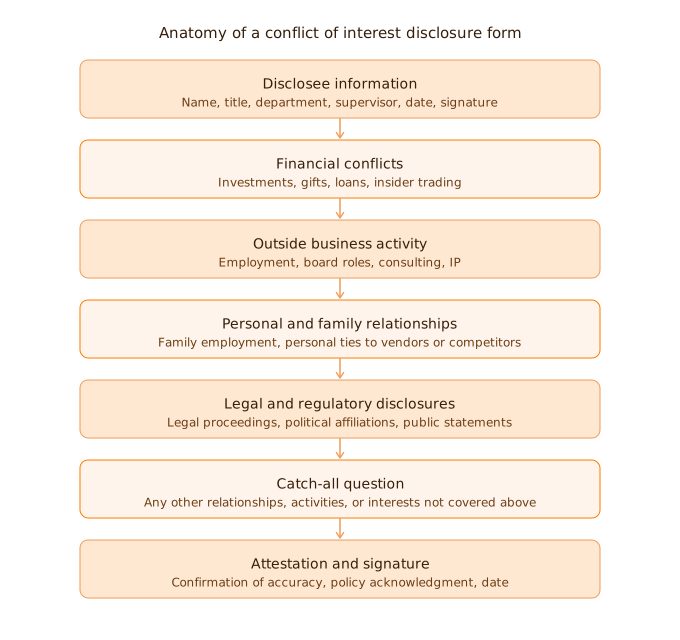
Start with the Basics: Disclosee Information
Every form should establish who is submitting the disclosure before any questions are asked. This means collecting full legal name, job title, department, direct supervisor, date of submission, and the disclosure period being covered. These fields seem obvious, but missing any of them can undermine the form’s standing if a disclosure is ever challenged.
A signature line, whether it be a physical or an electronic signature, is not optional. Without it, the form is not a disclosure, it’s just a survey. The signature confirms not only that it was the employee themselves who were submitting the form, it indicates that they understood what they were submitting and completed it honestly, which becomes important if circumstances are ever disputed down the line.
Financial Conflicts
Financial conflicts are among the most common and the most consequential, which is why they belong near the top of every conflict of interest disclosure form. The form should ask whether the employee or any immediate family member holds a financial stake in any vendor, supplier, or competitor, including stock ownership, equity stakes, and profit-sharing arrangements. One important instruction to call out at this point in the form: the threshold for disclosure should be defined by the organization, not left to the employee to interpret on their own.
The form should also ask about gifts, gratuities, and anything else of value received from outside parties. Setting a clear dollar threshold, such as anything over $25 or $50 for example, removes ambiguity, and specific categories like meals, event tickets, and travel should be named explicitly so employees do not assume common perks are excluded.
Beyond gifts, the form should ask about personal or planned future investments that could influence professional decisions, as well as any loans to or from a vendor, supplier, or business partner. Many companies don’t consider loans as a conflict of interest, but depending on the industry you operate in, this can be a surprisingly large gap in an otherwise solid form.
Sample Questions
- Do you or your family members have any financial interests or stocks in vendors, suppliers, or companies that could be considered a potential conflict of interest?
- Have you received any gifts, gratuities, meals, event tickets, or travel from any vendors, contractors, or suppliers that could influence your decisions regarding their business dealings with our organization?
- Do you have any personal or planned future investments that could conflict with your duties or influence your decision-making at our organization?
- Do you have any personal loans or financial obligations—to or from a vendor, supplier, or business partner—that could create a conflict of interest with your work here?
- Do you have access to any non-public information about our organization or its customers that could be used for personal financial gain?
Outside Business Activity
Employees with outside business interests are not automatically disqualified from anything, but your organization needs to know what those interests are. The form should ask whether the employee holds any secondary employment, consulting arrangements, or freelance work with any party that does or could do business with you. This includes arrangements that are informal or unpaid, since the relationship itself (not just the compensation) is what creates the potential conflict.
Board memberships and advisory roles deserve their own question, as well. Serving on the board of a vendor or competitor is an obvious conflict, but it is one that many forms fail to ask about directly. The same goes for licensing agreements, contracts, or intellectual property the employee owns that could be relevant to their work. If an employee is collecting royalties on something your organization is considering licensing, that needs to be on the table.
Sample Questions
- Do you have any outside employment, consulting arrangements, or freelance work with any party that does or could do business with our organization?
- Are you involved with or serving on the board of directors or advisory board of any vendor, supplier, or competitor?
- Have you entered into any licensing agreements or do you hold any intellectual property—patents, copyrights, or licenses—that could be relevant to your work at our organization?
- Have you received, or do you anticipate receiving, any sponsorship or funding from outside organizations that could create a conflict with your duties here?
Personal and Family Relationships
Relationships that do not show up on a balance sheet can influence decisions just as much as financial ones, and they are easier to overlook on a poorly designed form. The form should ask whether any immediate family members including spouses, domestic partners, parents, siblings, or children are employed by or have a business relationship with a competitor, vendor, or customer of the organization. Naming the relationships explicitly matters here, because vague language like “close relative” leads to inconsistent reporting and gives employees too much room to self-determine what counts.
Beyond family, the form should ask whether the employee has any personal relationships with individuals at a vendor, contractor, or competing organization that could be perceived as leading to preferential treatment or biased decisions. The standard is perception, not intent, and that distinction should be clearly communicated in the form language itself. An employee may genuinely believe a friendship has no bearing on their work, but the organization still needs to know the relationship exists to avoid an apparent conflict of interest.
Sample Questions
- Do you have any family members — spouse, domestic partner, parent, sibling, or child — who work for or have a business relationship with a competitor, vendor, or customer of our organization?
- Do you have any personal relationships with individuals at a vendor, contractor, or competing organization that could be perceived as leading to preferential treatment or biased decisions?
- Do you have any family-owned businesses or financial interests that could create a conflict with your duties at our organization?
Legal and Regulatory Disclosures
Certain legal and regulatory circumstances create conflicts that the organization needs to know about regardless of financial or personal ties. The form should ask whether the employee is currently involved in any legal proceedings that could create a conflict with their role, as well as whether they anticipate any future involvement. This is not about prying into their business, it is about making sure the organization is not caught off guard by something that was already in motion.
Political affiliations and public statements belong in this section, too. The form should ask whether the employee has any political activities or affiliations that could create the appearance of a conflict, and whether they have made any public statements that could be perceived as conflicting with your organization’s mission or obligations. This is especially relevant for organizations operating in regulated industries, government contracting, or any public-facing capacity where the line between personal opinion and institutional representation can get blurry fast.
Sample Questions
- Are you currently involved in, or do you anticipate future involvement in, any legal proceedings that could create a conflict of interest with your role at our organization?
- Do you have any political affiliations or activities that could create the appearance of a conflict or influence your decisions on behalf of our organization?
- Have you made any public statements that could be perceived as conflicting with our organization’s mission, obligations, or values?
- Do you participate in any non-profit organizations whose mission or activities could be perceived as creating a conflict with your work here?
The Catch-All and Attestation
Even a well-designed conflict of interest disclosure form cannot anticipate every scenario. A catch-all question at the end can be a smart idea. Include something like, “Do you have any other relationships, activities, or interests not covered above that could be perceived as a conflict of interest?” This gives employees the opportunity to disclose anything the form did not specifically ask about, and it shifts responsibility to the employee. If they skip this question and a conflict surfaces later, it is harder for them to claim the form simply did not cover it.
The attestation section should close the form with a clear statement of understanding. The employee should confirm that the information they provided is complete and accurate to the best of their knowledge, that they understand the organization’s conflict of interest policy, and that they are obligated to update the form if their circumstances change. Then, they need to provide a signature, their printed name, and the date. This is the section that transforms a filled-out form into an actual record of disclosure.
How Often the Form Should Be Completed
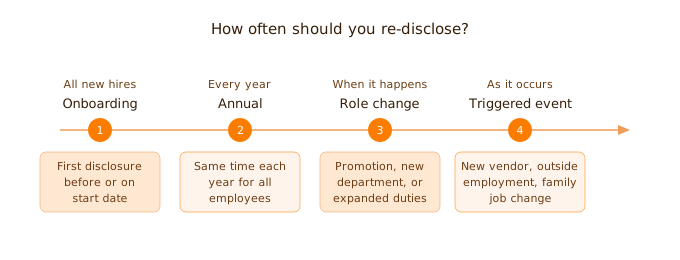
A conflict of interest disclosure form completed once at hire does not a compliance program make. Circumstances are bound to change. Employees may take on consulting work, family members will likely change jobs, new vendor relationships form, and personal financial situations shift. A form that only captures the moment someone was onboarded will not reflect reality several years down the road.
Annual re-disclosure is the baseline standard as it ensures the form reflects more current circumstances, and it keeps conflict of interest awareness on employees’ radar rather than something they sign off on and forget. However, we don’t believe annual cycles alone are enough.
Organizations should also require triggered re-disclosure any time an employee’s role changes significantly, a new vendor or supplier relationship is established, or a relevant personal or financial event occurs. Your form itself should state clearly how often disclosure is required and what specific circumstances call for an out-of-cycle submission, because if employees do not know when they are supposed to re-disclose, they will not do it.
Build Better COI Disclosures with ComplianceBridge
A well-designed conflict of interest disclosure form is only the starting point. Collecting disclosures, tracking responses, following up on gaps, and keeping records audit-ready is where most manual processes break down. ComplianceBridge makes the entire process easier to manage, from building custom question sets tailored to your organization’s risk areas, to automating submission, reminders, and re-disclosure cycles.
With ComplianceBridge, you can weight questions by importance, add conditional follow-up questions based on how someone responds, and monitor submissions in real time so nothing falls through the cracks. Whether you are building a COI program from scratch or tightening up an existing one, the platform is designed to reduce administrative burden without sacrificing thoroughness.
Ready to see how it works? Request a demo today and find out how ComplianceBridge can simplify conflict of interest disclosure for your entire organization.