A conflict of interest does not have to involve a bribe or a handshake deal to create real exposure for your organization. A conflict can develop in new territories that have quietly expanded with the dawn of the digital age in which understanding the shifting nature of a conflict of interest at work is becoming an increasingly intricate endeavor. Our traditional understanding, once limited to straightforward professional entanglements, is now eclipsed by more intricate dilemmas. The advent of social media, the rise of remote work, and the pervasive nature of digital communication have served to blur the lines between personal and professional lives in unprecedented ways.
Addressing these conflicts demands more than simply adopting a set of rules or guidelines. Though it requires a deep, nuanced understanding of this new digital landscape, most organizations are managing this expanded territory with policies and processes built for a narrower problem. This article breaks down five specific ways conflict of interest shows up in digital environments, what makes each one hard to spot, and what a modern compliance program needs to do about them.
Online Vendor and Financial Relationships
Historically, the clearest category of conflict of interest at work has been financial conflicts, but digital tools have made these relationships easier to form, harder to trace, and simpler to conceal. As more of our lives are conducted and shared online, equity stakes, referral arrangements, and revenue-sharing agreements develop increasingly through apps and platforms rather than formal documents.
An employee responsible for vendor selection may have a financial stake in one of those vendors that exists entirely online and never appears on a traditional disclosure form. Referral fees paid through a third-party app are easy to omit from a paper disclosure form that only asks about ownership stakes. Revenue-sharing arrangements with freelance platforms create financial ties that standard vendor conflict questions are not written to catch.
The disclosure forms used by most organizations were designed to catch traditional financial entanglements and often do not ask the right questions to surface digital ones. Generic annual forms rarely ask about online financial arrangements, platform-based income, or referral relationships, making a conflict of interest at work more difficult to identify. Role-based questionnaires that ask procurement and finance staff specifically about online financial relationships catch what generic annual forms miss. Targeted question sets by role are more likely to unveil relevant conflicts than broad forms sent to all employees once a year
Social Media and the Perception Problem
Social media platforms are not just the recreational spaces they once were where people posted pictures of food with snappy captions; today, they’ve become arenas where personal, professional, and public spheres intersect. This intersection, while beneficial for networking and communication, can also lead to a perceived conflict of interest at work. Since social media has collapsed the distance between an employee’s personal identity and their professional role, the subsequent overlap creates conflict of interest risk that most policies were not written to address.
Personal and professional accounts are often linked, making it easy for clients, vendors, and colleagues to see activity that was not intended for a professional audience, increasing the chances of a conflict of interest at work. A public endorsement, a follow, a share, or a comment can signal a bias or an undisclosed relationship even when no formal policy has technically been violated. Consider the following scenarios:
- An employee who publicly endorses a vendor on LinkedIn while also being responsible for that vendor’s contract renewal
- A board member whose social media activity reveals a financial interest that was never disclosed to the organization
- A manager who publicly criticizes a competitor with which their employer has a partnership
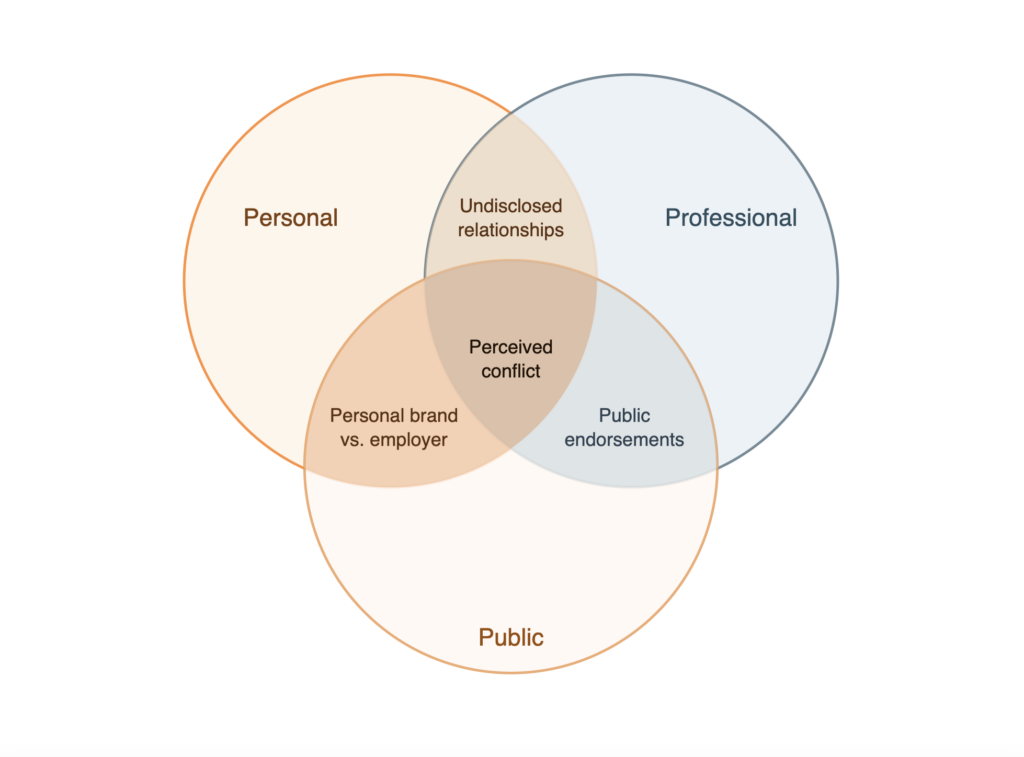
Perception matters here as much as fact; when a decision-maker’s social media activity calls their impartiality into question, trust in the decision erodes regardless of whether the conflict was real. A perceived conflict of interest at work can be as damaging to organizational credibility as an actual one, particularly in regulated industries. Social media policies and conflict of interest policies are typically maintained separately, which means neither one fully addresses situations where the two overlap. A coordinated review cycle for both documents reduces the likelihood of gaps between them.
Remote Work and the Secondary Employment Gap
Remote work removed the physical visibility that once made secondary employment and outside business activity easier to observe and that loss of visibility has made this one of the fastest-growing conflict of interest blind spots. In a traditional office, a manager might notice signs of divided attention or conflicting commitments; remote work makes those signals much harder to read. It is significantly harder for a manager to spot a conflict of interest at work when their employees are not physically at work.
Holding a second job or running an outside business does not automatically constitute a conflict of interest, but while it should be disclosed, it frequently goes undisclosed. A full-time employee doing paid consulting work for a direct competitor would most certainly be categorized as a conflict of interest at work. Other examples include a remote worker using company-issued equipment or licensed software for a personal side business or an employee whose outside role creates a scheduling or availability conflict that affects their primary responsibilities.
Remote work policies that focus exclusively on productivity, hours, and equipment use tend to skip the conflict of interest question entirely. Most remote work agreements were drafted quickly during the pandemic and have not been updated to include provisions for a conflict of interest at work.
Disclosure requirements should explicitly cover secondary employment, freelance arrangements, and outside board or advisory roles, and should be triggered by role changes rather than limited to annual cycles. An employee who changes roles mid-year may acquire new conflict exposure that an annual form will not capture for months. Triggered disclosure workflows remove the burden of remembering to report and make timely disclosure the default.
Digital Communication Platforms and Hidden Favoritism
Platforms like Slack, Microsoft Teams, and email have moved professional relationships into private channels where they can develop and influence decisions without being visible to the broader organization. Private channels and direct messages create relationship dynamics that are functionally invisible to compliance oversight, making a conflict of interest at work a proverbial needle in a haystack.
Favoritism rooted in digital relationships is one of the harder conflict of interest scenarios to detect because it does not produce a document trail until after a biased decision has already been made. A conflict of interest at work might come in the form of a manager that consistently routes high-visibility assignments to a certain employee – the same employee with whom the manager communicates frequently in direct messages. A procurement officer’s vendor selection may be influenced by a relationship that formed entirely over email.
The problem here is not the platforms themselves but the absence of disclosure norms that account for how relationships now form and operate. Organizations that treat digital communication as a transparency issue rather than a surveillance issue are more likely to build programs that employees trust. Making disclosure easy and expected is the most effective way to bring awareness to these relationships before they influence decisions. When employees know what needs to be disclosed and have a simple way to do it, most will. Complexity and annual-only timing are the two biggest reasons conflicts go unreported.
Data Access and Digital Insider Risk
Access to sensitive organizational data creates a category of conflict of interest that has no real analog in the pre-digital era. Employees with access to pricing data, client lists, financial projections, or proprietary systems hold leverage that can benefit a competitor, a side business, or a personal financial position, creating a conflict of interest at work that could have profound impacts.
An employee does not need to steal data to create a conflict; simply having access to sensitive information while holding an undisclosed outside interest is enough to constitute one. A finance employee with access to unreleased earnings data who also holds a significant personal investment in the company could present a conflict of interest at work as could an IT administrator with system access while also doing contract work for a vendor that supplies software to the same organization. A sales employee who has access to a full client list could be building a competing business on the side using that information.
This type of conflict is especially difficult to detect because the data access is legitimate; the conflict resides in what the employee does, or could do, with that access. Most organizations separate data governance from conflict of interest management, which means neither program is looking at the full picture. Connecting role-based data access reviews with conflict of interest disclosure cycles gives compliance teams a more complete view of where insider risk actually lives. Employees in high-access roles should face more frequent and more specific disclosure requirements than the general employee population.

What a Modern Conflict of Interest Program Needs to Include
Technology, the harbinger of digital conflict of interest at work, also holds the keys to their resolution. In the past managing conflicts of interest meant file cabinets filled with disclosures and employee-signed forms stating they understood the policies, today conflict of interest management platforms simplify the process. Most existing conflict of interest programs were designed around a single annual disclosure form, and that model is not built to handle the range of scenarios covered in this article. Annual cadence means a conflict disclosed in January may not surface until the following January if it develops after the form goes out.
A program that keeps pace with digital-age conflicts needs four things that traditional programs typically lack:
- Role-based question sets that ask different employees different questions based on their actual exposure
- Triggered disclosures when employees change roles, take on outside work, or gain access to new systems or data
- Audit trails that document the full disclosure history without relying on physical files or manual tracking
- Dashboard visibility that gives compliance officers a real-time view of response rates, flagged disclosures, and open reviews
ComplianceBridge’s conflict of interest module is built around each of these requirements. Adjustable disclosure frequency, custom question sets, automated reminders, approval staging, evaluator assignment, and a complete audit trail. The goal of the program is not to catch employees doing something wrong; it is to make disclosure easy enough that conflicts surface before they affect decisions.
Looking Towards the Future of Conflict of Interest
The five scenarios in this article are not edge cases; they are the everyday reality of how conflicts of interest develop when work happens online, on mobile devices, and across platforms that did not exist when most conflict of interest policies were written. Organizations that update their programs to reflect how work actually happens now, and use technology to enforce consistent and timely disclosure, are in a fundamentally stronger position when questions arise.
As we continue to traverse this ever-changing digital landscape, the complexity of conflicts of interest in the workplace will likely continue to grow. Nevertheless, by understanding these potential conflicts and using innovative technology solutions, organizations can navigate this challenging terrain. But there’s no reason to navigate it alone. That’s where ComplianceBridge’s Conflict of Interest software comes into play.
Our solution is robust, offering regular and adjustable disclosures, custom question sets for comprehensive assessments, automated reminders and notifications to keep your process streamlined, and approval staging to ensure organization-wide consensus prior to deploying a questionnaire. Additionally, audit trails provide simplified auditing and the dashboard helps you review and manage responses effectively. With the capability to assign evaluators and flag low compliance, you can rest assured that conflicts of interest are being managed effectively.Are you ready to transform the way you manage conflicts of interest? Request a free demo today to see our platform in action!