Have you ever purchased a new toy, gadget, or appliance and carefully read the instruction manual (a great resource), but for some reason it just won’t work? Perhaps you missed a step or excluded a critical part. Maybe there was a tripped breaker or GFCI outlet, the instructions were vague or there was an error in the manual. Sometimes you need to consult Reddit or YouTube for additional training to better understand your specific situation. Likewise, organizational policies alone are great resources, but apart from compliance training they often fail to accomplish the desired results.
Most organizations invest significant effort into drafting policies yet struggle to ensure those policies are consistently understood and followed. Compliance training bridges the gap between written policies and day-to-day decision-making. Without training, policies remain static documents that employees may acknowledge but not fully interpret or apply. This article explores how compliance training supports policy understanding, consistency, and long-term adoption.
The Relationship Between Policies and Compliance Training
Bob in purchasing and Nancy in receiving show up on time to work, do a good job, and expect to receive compensation; they likely spend their commutes listening to a podcast or the radio, not contemplating the interplay between workplace safety, employee culture and regulatory compliance. They probably aren’t quizzing themselves on work policies to ensure they understand and retain the material.
Policies are important, though. Just as important is the investment in ensuring that your employees do understand and retain their contents. Integral to an organization’s daily operations, policies define expectations, rules, and standards of behavior. Compliance training provides the context employees need to interpret and apply those policies correctly. Training reinforces how policies relate to specific roles, responsibilities, and scenarios. Together, policies and training form a complete compliance framework; compliance training is the glue that makes policies stick!
Why Policies Alone Often Fall Short
Because board members, executives, and other top-tiered associates or policy administrators have a broad understanding of the company as a whole and extensive knowledge of the organization’s mission, vision and values, they approach policies from a more complex perspective than most of the employees for whom they are designed. Add to that legal considerations and the results are written policies that can be dense, too technical, or open to interpretation.
When policies are vague or ambiguous, who or what is the main information source for all issues related to policies? Who or what is the go-to for policy related questions?
Inconsistent interpretation across departments leads to uneven enforcement. Who or what ensures that policies are enforced evenly, fairly, and consistently? Who or what notifies employees that policies have been revised? Without compliance training, updates to policies may go unnoticed or misunderstood.
Employees may acknowledge policies without fully understanding their implications. This is not an indictment; most of us are likely guilty of clicking on “I agree to the terms” when downloading an app although we haven’t fully read them. That is a personal decision that impacts nobody else but oneself, whereas one’s understanding of a company policy has great potential to impact not only co-workers, but the entire organization. Who or what ensures that employees do indeed understand policies’ implications?

Compliance Training Creates Shared Understanding
Like a spider’s web that stretches from a fencepost to the wheelbarrow and over to the garden trellis, compliance training reaches across departments, traverses the org chart, and connects all parts of the organization with the same thread. Establishing a consistent baseline for how policies should be interpreted, compliance training helps clarify gray areas and common misconceptions.
Regular training reinforces key policy principles over time. Let’s face it, unless we are in the field of chemistry, our chances of successfully balancing a difficult chemical equation are slim. The adage is true; “use it or lose it.” Mandating regular compliance training will enhance retention across the company, generating a shared understanding, reducing confusion and conflicting interpretations, and creating an environment of equal buy-in and a dedication to compliance from all employees.
Reinforcing Policy Changes Through Training
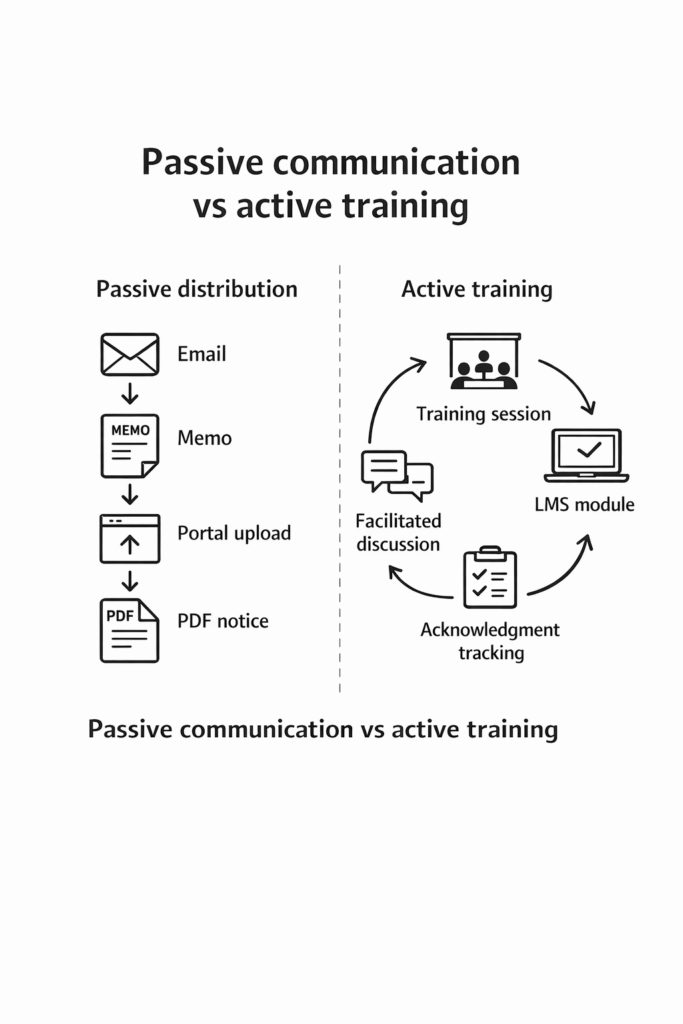
Policies evolve as regulations, operations, and organizational priorities change. The mechanism for conveying these changes to employees across the organization can be just as important as the changes themselves. Consider the possible outcomes when your organization sends out a memo with a directive to implement a new cover sheet on the TPS reports. In the absence of compliance training, employees may miss the memo altogether, the memo may get buried amid their other daily tasks, or employees may fail to implement the directive because it isn’t clear to them.
When directives are vague, employees tend to respond in one of three ways:
- Ask (for clarification from the policy owner)
- Avoidance (since it isn’t clear, employees avoid it)
- Attempt (to interpret it personally or with the help of colleagues)
Well-meaning but misguided employees may emerge and lead less engaged or less assertive employees in the wrong direction. Training provides a structured way to communicate updates without relying on email or passive distribution. Compliance training ensures employees understand what changed and why. Reinforcement helps prevent outdated practices from persisting. Asking for clarification from the policy owner is the best response to ambiguity, but that necessitates accountability and a clear policy owner.
The Role of Accountability in Policy-Driven Training
Compliance training is most effective when responsibility for policy communication is clearly defined by designating an employee who acts as a policy administrator for the company. A policy administrator is responsible for leading employees through the entire policy creation process including policy development, policy distribution, compliance training and ongoing policy management.
Because they oversee the policy from conception to inception and beyond, policy administrators are invested and engaged. As those most familiar with and attuned to the policy, they act as policy guides for the other employees. Therefore, it is imperative that this role be occupied by a skilled facilitator or trainer with administrative expertise. Compliance training often includes a hands-on effort in which the policy administrator facilitates the testing of policies for compliance and understanding with the assistance of other employees and stakeholders to further individualize the training.
Policy administrators are guides, leaders, teachers and trainers with leadership skills and commitment to the organization. A clearly defined policy administrator role broadcasts the mantra, “the buck stops here,” enhancing accountability, which ensures training aligns with current policy language. Clear ownership helps keep training content accurate and up to date, whereas with a lack of ownership, policies and training can quickly drift out of sync.
Documentation and Acknowledgment Matter
A designated policy administrator is a great mechanism for accountability on the company-side; someone is responsible on behalf of the company to oversee compliance training. Training records, conversely, hold employees accountable; they demonstrate that employees were informed about policies. Acknowledgments support consistency and transparency. Centralized records make it easier to reference who was trained, when they were trained, and on which policies they were trained. Documentation reinforces the connection between policies and training.
A very small fledgling company with less than ten employees may be able to track compliance training with a notepad and pen, but that is not so with larger organizations; with organizational growth comes a greater imperative to document. No matter how small the company is, formal documentation is wise. Not only does it “CYA” but it is scalable, which is critical for any company with a desire to grow.
Scaling Policy-Centered Compliance Training
As organizations grow, informal training becomes harder to manage. On top of guiding policy committees through the process of developing sound, relevant policies, coordinating reviews and approvals of policies, publication and notification of new policies and procedures and more, the role of policy administrator as singular trainer becomes more than one person – even the most organized person – can handle effectively.
The only way to scale effectively is with policy management software at the helm of your policy and procedure management system, which coordinates the policy process from start to finish, minimizing arduous work, ensuring accuracy, and managing data with precision. Centralized systems help standardize policy training across teams and locations. Scalable compliance training ensures new hires and existing employees receive consistent messaging. Technology supports alignment between policies, training materials, and records.
Streamline Compliance Training With ComplianceBridge
Strong policies and procedures need a stout management platform. With the ability to provide comprehensive and relevant training, offer rewards and recognition, solicit employee feedback, and communicate policies and procedures effectively, ComplianceBridge can bridge the gap between what your policies say and what your employees do. Trusted in every industry, creating satisfied customers for over 20 years, ComplianceBridge has helped HR professionals worldwide streamline their compliance training while helping solve a host of other problems with one simple solution.
Our policy management software with customizable workflows, simple collaborative policy creation tools, automated policy updates and distribution is a policy administrator’s dream come true. With automated reminders, notifications, and reports, you will have better insight into your employee’s compliance with company policies and procedures. By ensuring that your employees have the knowledge and skills they need to comply with your organization’s policies, you can mitigate compliance risks and create a culture that prioritizes integrity and accountability.
Investing in ComplianceBridge means enhancing your compliance training – the glue that gets your policies to stick! Request a demo of ComplianceBridge today!
Request a Demo Today
See our product in action with your own private demo. During the live demo we cover key functionality plus any detail you want. Pick your date and time now, and let us know what is most important to you.