Conflict of interest disclosure is an absolutely critical risk mitigation process for all organizations, corporations, and institutions. Unfortunately, COI disclosure is often also a time-consuming, tedious process, especially when you do it the old-fashioned way with paper forms and filing cabinets. It’s also not the best when you do it the slightly newer old-fashioned way, with emails and manual-entry digital spreadsheets. Those tools weren’t meant to manage conflict of interest disclosure, and it shows. Conflict of interest disclosure software, however, makes this cumbersome task both more manageable and more effective as a risk mitigation tool.
In this article, we’ll cover everything you need to know about conflict of interest disclosure software, from what COI is and why it matters, to what the right software solution can do for your business.
What is Workplace Conflict of Interest?
Everyone has a life outside of work — or at the very least, they should — which means that everyone has external relationships and interests that could become a conflict of interest for them.
When we talk about conflicts of interest, we’re referring to any situation in which any of these financial or personal interests conflicts with an employee’s responsibilities to their employer. Workplace COI can manifest in a number of ways and forms, including:
- When an employee or one of their family members has a financial interest in a competitor
- Accepting gifts or favors from clients or vendors, which may compromise (or appear to compromise) the employee’s impartiality
- An employee forming personal relationships with customers or suppliers, or giving them preferential treatment
- An employee using their position to advance their personal or financial interests, such as securing a business deal for a close friend or family member
- Conflicting business interests, such as when an employer secures a deal that will benefit their undisclosed side business
Workplace conflict of interest can seriously compromise, or appear to compromise, an individual’s objectivity and judgement. Biased decision-making that results from these conflicts can have serious ethical implications. It can also incur regulatory, reputational, or even legal damage for the entire organization.
Conflict of Interest Disclosure
COI disclosure processes are designed to catch potential conflicts that workers may have, before that conflict becomes an issue for their employer. The rules regarding which employees need to disclose COI differ depending on the nature of the workplace. You may only have a few key personnel whose potential conflicts would pose a risk to your business or mission, or you may require that everyone disclose potential conflicts of interest.
The disclosure forms themselves also vary. Some organizations may feel comfortable with relatively simple questionnaires, while others may be more extensive. The most common type of conflict employers ask about is financial COI, or FCOI. FCOI constitutes any financial relationship someone has with an external entity. Owning stock in a rival company, donating to an outside organization, or receiving gifts from vendors are all examples of FCOI.
Other conflicts can be more personal, though, such as nepotism or self-dealing. It’s at the discretion of an employer what they ask employees to disclose and how much information to provide in an instance of COI.
The process itself is normally conducted annually and follows these steps.
- Employees fill out a COI disclosure form that includes questions about any relationships or outside interests from which a conflict could arise.
- After submission, the disclosure form is reviewed by a Compliance Officer or a similar entity. Most disclosures will be “negative disclosures”, meaning that an employee had nothing to disclose or that a disclosure did not constitute a conflict.
- In the instances that an employee does have a qualifying outside interest to disclose, reviewers must consider factors such as the size of a financial transaction, the duration of a professional relationship, and how the public might perceive a situation to determine if it’s a conflict of interest. If reviewers determine an outside relationship is a conflict of interest, then it’s called a “positive disclosure”.
- Positive disclosures must then be effectively managed in some way. Examples of managing a conflict of interest could be requiring an employee to sell off stock in a company, limiting their role and responsibilities in some way, or disclosing the conflict to stakeholders and the public before they find out another way.
While the disclosure process may seem straightforward, when you have to juggle responses to dozens of different questions from hundreds of employees, it becomes anything but. This is where conflict of interest disclosure software comes into play!. If we review the process with the addition of a software solution, we can see the experience improves for all parties involved, and leads to more trustworthy results.
The Benefits of Conflict of Interest Disclosure Software
Eliminating Hard Copy Forms & Recordkeeping
Unlike some other risk management activities, COI disclosure often gets treated as a low-priority administrative task. Since many organizations already manage disclosure with basic tools like email and Google Forms, there’s rarely a push to invest in something more robust, even when a dedicated solution could make everyone’s job easier.
So administrators and reviewers get left to distribute disclosure forms via email, save submitted responses in shared drives or inboxes, and track results in spreadsheets that must be manually updated. And when someone needs to make an ad hoc disclosure outside of the usual disclosure cycle, they simply have to do their best to manage it with a rudimentary form process that was never intended for COI.
Manual systems for COI disclosure come with a whole laundry list of potential problems:
- An inability to ensure all employees have submitted forms
- Difficulty digging through cluttered inboxes and shared folders to track down the right responses
- Disclosures getting lost or employees getting missed in the shuffle
- Manual entry mistakes from inputting results into spreadsheets
All of these issues ultimately create an unreliable, inefficient process that fails to uncover and fully address all potential conflicts of interest that pose a threat to your business.
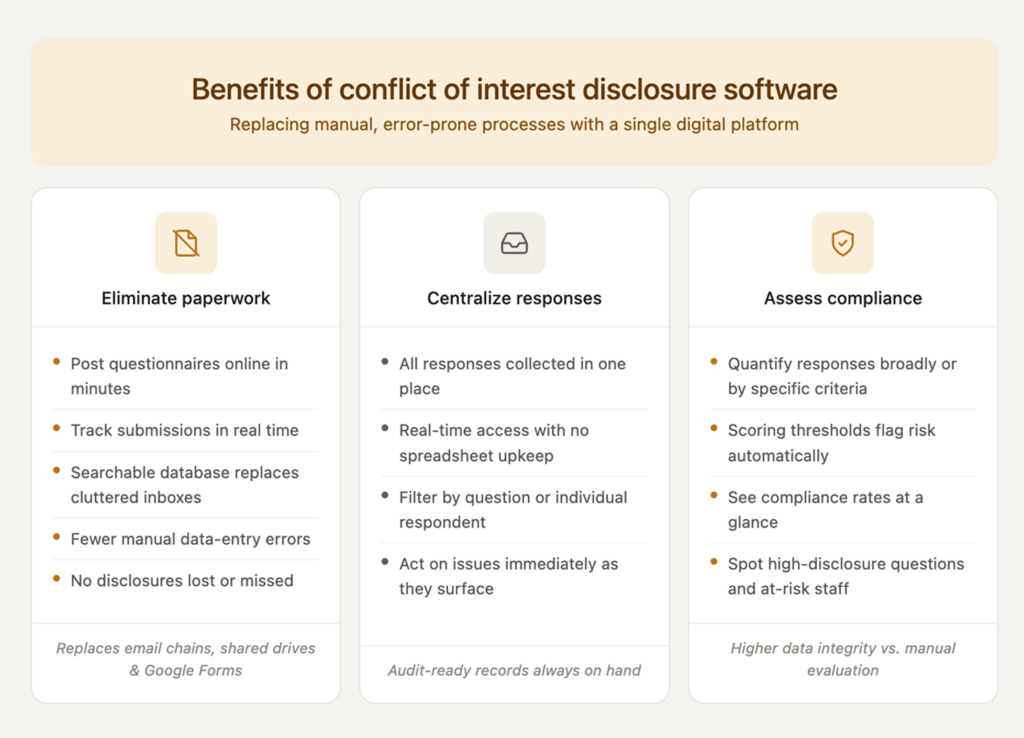
Conflict of interest disclosure software eliminates the stressors created by cobbled-together manual processes, allowing you to conduct the entire process digitally in one place. Conflict of interest disclosure software gives users the power to create and post questionnaires online in a matter of minutes, easily track who has and hasn’t yet submitted their answers, and utilize a searchable database to find exactly what you’re looking for when you need it.
Unlike scattered files and email threads, software can’t be lost or buried, and administrators won’t be required to manually input nearly as much information, which means there will be less opportunity for errors.
Collecting Responses in One Place
Collecting and reviewing responses may be the most time-intensive part of traditional COI disclosure workflows. While the vast majority of personnel who respond won’t raise any issues, it’s the needles in the haystack you have to look out for. This is made even more difficult with the involvement of multiple processes managed by different departments.
Conflict of interest disclosure software collects all responses in a centralized location, ensuring that no responses get missed or skipped over. As responses come in, conflict of interest disclosure software gives you the tools for in depth analysis, like isolating results for specific questions and from specific individuals.
Administrators or compliance officers will no longer need to worry about keeping manual spreadsheets updated with the most current information. Conflict of interest disclosure software skips that hassle, granting real-time access to responses. This makes it easier to react and investigate immediately when a potential conflict does get disclosed. COI software also serves as a repository for storing, organizing, and accessing records, saving your business a headache in the event of a compliance audit.
Easily Assessing Compliance With COI Policies
The purpose of collecting COI disclosures is to ensure that you and your employees remain compliant with any of the relevant policies your business has on the books. These policies help determine who in your organization is required to disclose, which types of conflicts must be covered, how you should manage positive disclosures, and how much risk you’ll tolerate on the matter of COI.
In other words, there’s a lot to cover. Manually evaluating COI compliance with policies quickly becomes a tedious exercise, and one often riddled with low data integrity.
Conflict of interest disclosure software allows users to quantify responses. Analysis can occur as broadly or narrowly as needed. Predetermined scoring thresholds make it easy to identify points of potential risk. At a glance, see the percentage of respondents who met compliance thresholds, which questions had the highest positive disclosure rates, and which employees were most likely to have a conflict of interest.
A Better Way to Disclose Conflict of Interest
Managing conflicts of interest doesn’t have to be a compliance headache. ComplianceBridge’s conflict of interest software is built to take the complexity out of the process. From building assessments to collecting responses, analyzing disclosures, and generating reports, everything lives in one place so your compliance team can work smarter, not harder.
Our conflict of interest disclosure software gives you the flexibility to design assessments that fit your organization’s unique needs, whether for an ad hoc disclosure or as part of an annual process. Choose from multiple choice, yes/no, fill-in-the-blank, ratings, and open-text response formats. If you need to dig deeper, conditional logic and external document references allow for a more thorough, nuanced disclosure process. Once submissions are in, you can drill down to individual answers, spot patterns across your workforce, and export the data for deeper analysis, without any manual lift.
Conflict of interest disclosure can have a massive impact on your organization’s integrity and risk profile. Don’t leave that to chance. Request a demo with ComplianceBridge today and see firsthand how our COI management tools can bring structure, confidence, and efficiency to your business.