Most organizations think of policies and procedures as documentation, not strategy. That is where things go wrong. When policies are unclear, outdated, or buried in a shared drive, employees cannot follow them consistently and compliance suffers. The organizations with effective policy management treat policies and procedures as living tools for alignment, not one-time paperwork exercises.
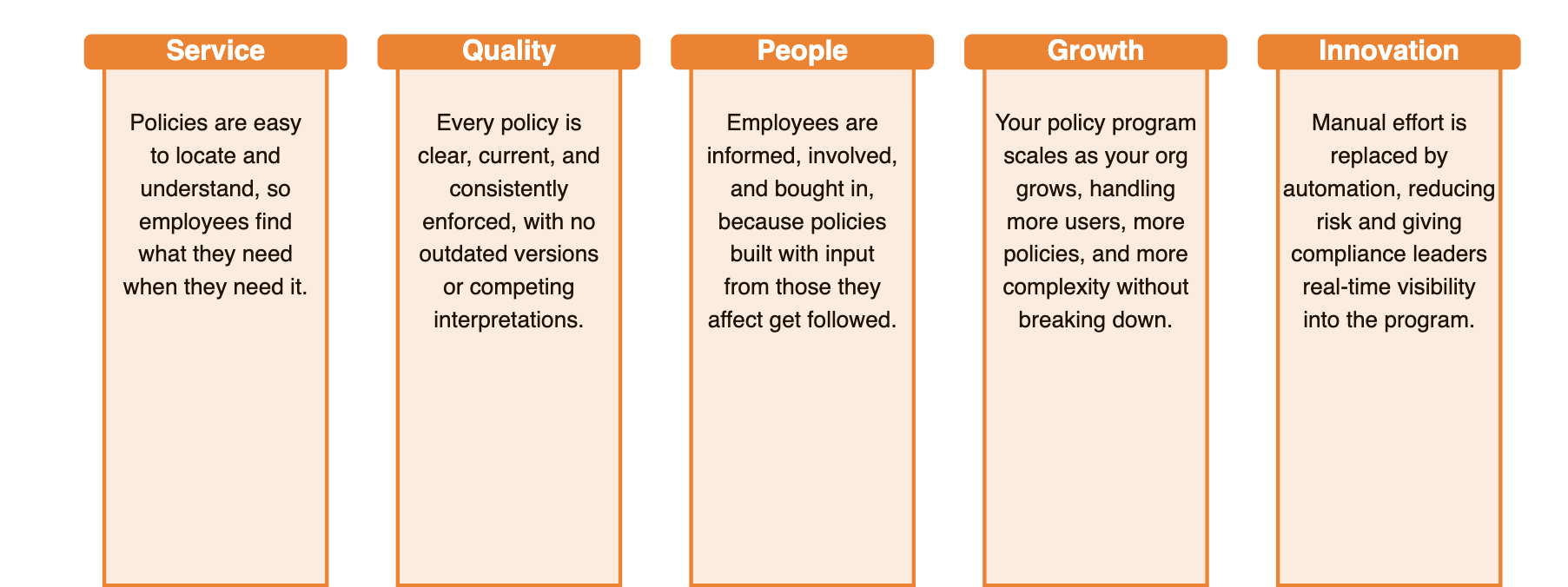
The five pillars of excellence give a practical framework for elevating policy and procedure management from administrative task to organizational asset. The pillars are: Service, Quality, People, Growth, and Innovation. Each one applies directly to how policies are written, maintained, distributed, and enforced. This article walks through each pillar, what it means in practice, and how to use it as a lens for improving your policy program.
Why a Framework for Policy Management Matters
Without a framework, policy management tends to be reactive; policies get updated after something goes wrong, not before. Policy reviews get missed, outdated versions stay in circulation, and employees, not sure which document is current, may use outdated versions with the potential to make costly mistakes. When an auditor or regulator asks for documentation, the scramble begins.
A framework promotes proactive policy management, giving policy owners a structure for making decisions before problems arise. It also gives leadership a common vocabulary for evaluating whether the policy program is truly serving the organization. The five pillars work as that framework. However, they are not abstract ideals – each one maps to specific, actionable decisions in the policy lifecycle.
Pillar 1: Service
From a business perspective, when we think of service, we often think of customer service – the assistance, advice, and support offered to both potential and existing customers. This could look like helping a client onboard your software, providing help if there are issues with a product, or simply remembering and appreciating customers with whom you’ve met before. Regardless of what customer service means in your industry, your approach to policies and procedures will have a direct impact on the level of service you can provide.
In the context of policy management, service means making it easy for employees to find, understand, and follow policies. A policy that exists but cannot be located quickly is not serving anyone. Neither is one that is written in legal language that employees cannot parse. Your goals under the service pillar should ultimately be aimed at improving the customer’s experience, but when a customer-facing employee cannot find a policy the moment they need it, the customer service experience suffers.
The service pillar pushes organizations to ask: are our policies readily accessible to the people who need them when they need them? Goals under this pillar might include reducing the time it takes to locate a policy, simplifying document structure, or improving mobile access. Role-based access is a practical application here – less is more. Employees should see the policies relevant to their job, not the entire library; forcing employees to sift through irrelevant data is a disservice to them.
Service also applies internally. Within an organization, different departments provide services to one another. In policy management, compliance teams serve policy owners by making the review and approval process straightforward instead of a bottleneck. Automated notifications and workflow tools reduce the manual coordination that slows down policy updates, enhancing the caliber of service within an organization.

Pillar 2: Quality
Quality in policy management means that every policy is clear, accurate, current, and consistently enforced. A well-written policy leaves no room for competing interpretations. If two managers read the same document and reach different conclusions, the policy has a quality problem. Outdated policies create quality problems at scale. If a policy’s most recent reviewed date is three years ago, employees and auditors both have reason to question its validity.
Quality depends on having a reliable review cycle, not just a one-time document creation process. Policy owners need scheduled review reminders and someone needs to be accountable when reviews are overdue. Version control is essential to ensure quality in policy management. Employees should never be able to access a superseded version of a document. Limiting access to current versions will prevent employees from answering customer queries with incorrect information, accidentally violating the law, or simply following an inefficient process when a better one exists. It ensures that the work your organization produces uses best practices and best practices alone.
Quality also applies to the acknowledgment process. Tracking who has read a policy and when they read it is not just a compliance formality. It is proof that the policy is actually reaching the people to whom it applies. Policies and procedures exist to enhance the quality of an organization, but if they are overlooked or neglected, the intended quality goals aren’t achieved. Gaps in acknowledgment data are often a sign that distribution was inconsistent or that the wrong employees were targeted. When policy management framework includes quality as one of the pillars, these gaps are closed.

Pillar 3: People
Policies exist to guide people. If employees do not understand, trust, or follow them, the program is failing regardless of how well the documents are written. Most compliance failures trace back to a people problem: the policy existed, but nobody followed it, or nobody knew it applied to them. When people is one of the pillars of excellence in policy management, the policies are crafted with people in mind and communicated to those people with careful consideration.
The people pillar focuses on inclusion, communication, and buy-in throughout the policy lifecycle. Exceptional policy management capitalizes on the collective contributions from the people most impacted by the policy. Involving employees in the drafting or review process increases the likelihood that the final policy reflects how work is truly performed. Front-line employees often surface practical conflicts that managers and compliance teams would never catch from the top down.
Communication strategy matters as much as document quality. How a policy is announced shapes how it is received. Framing a new policy around the problem it solves, rather than issuing it as a top-down mandate, tends to reduce friction and improve adoption. Whereas blanket distribution of every document to every employee is noise, targeted distribution ensures that employees only receive policies relevant to their roles.
No pillar can stand without a firm foundation; the people-pillar stands on the foundation of rock-solid leadership. No matter how well an organization has crafted their policy management approach or how clearly they have set the expectations for employees, leadership sets the tone. When managers actively reference and follow policies, employees take them seriously. When managers work around them, the culture follows.

Pillar 4: Growth
Growth is usually a sign of a healthy organization and likely a goal of all organizations. With growth comes growing pains, among which is policy stress. New locations, new regulations, expanded headcount, and acquisitions all put pressure on a policy program that was built for a smaller or simpler organization. Organizations that manage growth well treat their policy infrastructure as something that needs to scale, not just expand.
The growth pillar asks: can your current policy management system handle more policies, more users, and more complexity without breaking down? Manual systems built on spreadsheets, shared drives, or email threads do not scale. They accumulate errors as volume increases. Departments begin keeping their own policy copies. Nobody is sure which version is live, making version confusion a recurring problem.
Growth also means building policies that are flexible enough to accommodate change without requiring a complete rewrite every time something shifts. Modular policy structures, where core principles are separated from operational procedures, tend to age better than monolithic documents.
A policy program built for growth includes a governance model: defined owners, review cycles, escalation paths, and a clear record of who approved what. If a policy management system lacks governance, growth produces chaos. With it, growth is much more manageable.

Pillar 5: Innovation
Innovation in policy management does not mean writing creative policies. It means using better tools and smarter processes to do the work more effectively. Organizations that still manage policies through email chains, Word documents, and manual tracking are using the same methods they used 20 years ago. The risk of that approach increases as organizations get larger, more distributed, and more heavily regulated.
The innovation pillar asks: where does manual effort create risk and what would change if it were automated? Automated review reminders eliminate the risk of policies lapsing because someone forgot to check a spreadsheet. Workflow automation for approvals removes bottlenecks and creates a documented audit trail without extra administrative work. Real-time dashboards give compliance leaders visibility into acknowledgment rates, overdue reviews, and approval status without chasing updates.
Not only does innovation in policy management eliminate risk through automation, it also includes how policies are delivered. Static PDF distribution does not confirm that the right person has read the right version. Targeted digital distribution with tracked acknowledgment closes that gap and creates defensible documentation.

Applying the Five Pillars of Policy Management Together
The five pillars are most useful when they are applied together, not treated as a checklist. A policy program can score well on quality but fail on people, producing well-written documents that nobody follows. It can serve employees well today but fail on growth, falling apart as the organization scales.
Using the pillars as a regular evaluation framework helps identify where the policy program is strong and where it has gaps. A useful exercise is to rate each pillar on a simple scale and use the results to prioritize improvement efforts. The organizations with the strongest compliance cultures tend to perform consistently across all five, not just the ones that feel most urgent.
When leaders make decisions through the lens of the five pillars, communicate using the vocabulary of the five pillars, and function according to them, excellence ceases to be a goal on a slide deck and starts showing up in daily operations. They create a culture of excellence among the people – a culture that is contagious, which leads to a positive upward cycle where excellence in one area contributes to excellence in another.
Using innovation to enhance internal service leads to top-tier customer service. Feeling a sense of pride in the quality of products or services rendered increases morale in the people and the organization attracts more quality people. As the quality of service increases, the customer base grows along with the demand, which necessitates organizational growth. Using innovation allows organic growth through scalability, while also boosting excellence in quality.
ComplianceBridge Supports All Five Pillars of Policy Management
Achieving excellence doesn’t have to be a struggle. With ComplianceBridge’s policy management software, excellence can be an inherent part of your organization’s culture. Supporting all five pillars of excellence, our software is designed to help you manage the entire policy lifecycle, from collaborative creation to targeted distribution to ongoing maintenance.
- Service: role-based access and a centralized, searchable policy library mean employees find what they need quickly, without calling compliance.
- Quality: automated review reminders, version control, and a complete audit trail keep policies accurate and defensible.
- People: targeted distribution, tracked acknowledgments, and collaborative drafting tools keep employees informed and involved.
- Growth: a scalable, cloud-based platform with configurable workflows handles increased complexity without requiring IT resources.
- Innovation: automated workflows, real-time dashboards, and integration with tools like Microsoft 365 and Google Docs replace manual processes with reliable systems.
Request a demo to see how ComplianceBridge maps to your organization’s specific policy management needs.