It probably goes without saying that most businesses have policies. But we at ComplianceBridge are saying it anyway, because far fewer of those businesses have reliable ways of gauging whether those policies have actually been received, read, and understood by employees. Without that transparency, companies may struggle to actually prove that policies and procedures are reaching workers in the event of an audit. Compliance and regulatory risk lives within the gap between having policies and having a functional policy program. Digital solutions in the form of policy and procedures software can close that gap.
In this article, we’ll explore the ways policy and procedures software can help businesses rise far above the limitations of manual policy management. If we listed all of them, we’d probably be here all day, so we’ve identified 10 of the biggest benefits that organizations who switch to policy and procedures software will see.
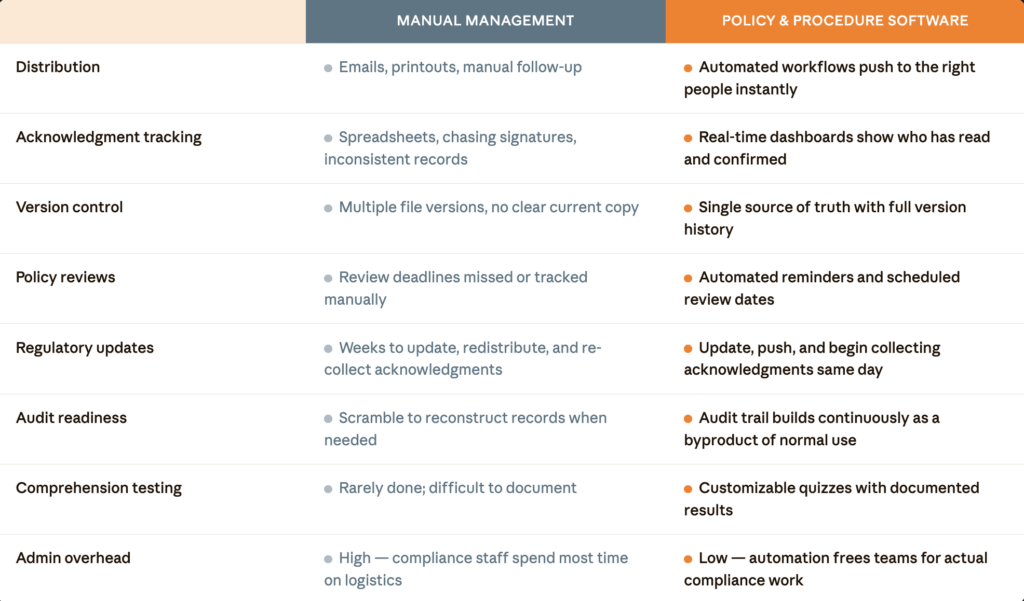
1. Show Your (Governance) Work
More and more, regulatory bodies require a company’s board members and executives to produce documented evidence of employee compliance. This goes beyond just assurances that those policies exist; Many bodies, including those governing healthcare, finance, and government contractors, require demonstrable governance records. Risk increases exponentially when businesses lack the resources necessary to establish that proof.
Enter policy and procedures software, which digitizes, centralizes, and documents policies and procedures, including employee compliance data. Policy management software creates a verifiable, time-stamped record of which policies exist, when they were reviewed, who approved them, and which workers read and acknowledged them. Governance transforms from something you can claim into something you can actually show.
2. Compliance Teams Get to Do Compliance Work Again
Ask any compliance manager what tasks occupy most of their time and you’ll probably hear the answer: chasing acknowledgments, resending documents, and constructing a timeline of who received what version of which policy, and when. After a certain point, that mad scramble looks less and less like compliance work and more like administrative overhead.
Policy and procedures software eliminates that overhead. Automated workflows policy and procedure distribution, reminders, and escalation without requiring human intervention. Policy management software also gives users version control, which ensures that employees always receive the most up-to-date iteration of that policy. With those time-consuming tasks off of their plates, compliance teams can devote more time and energy into actually managing compliance.
3. Risk Surfaces Before It Becomes a Problem
Compliance risk never announces itself; That would be too easy. Usually, risk just accumulates quietly in the gaps in your compliance workflows. Not only are manual processes incapable of closing those gaps, they’re much more likely to create them. Common examples of compliance risk include:
- Failing to review an out-of-date policy
- New hires missing acknowledgement
- Policy libraries that don’t include regulatory updates
It can be easy to let these and other risks go unnoticed in a bustling business, but organizations that catch problems suffer far fewer consequences if something does go wrong. Policy and procedures software solutions facilitates this by flagging compliance gaps in real time.
4. Policies Stop Accumulating and Start Getting Managed
Without a formal system for storing documents, policies and procedures experience library drift. Documents get created, distributed once, and then left to age in a folder, with no indicator of which version is the current one, or if that document has undergone any kind of review.
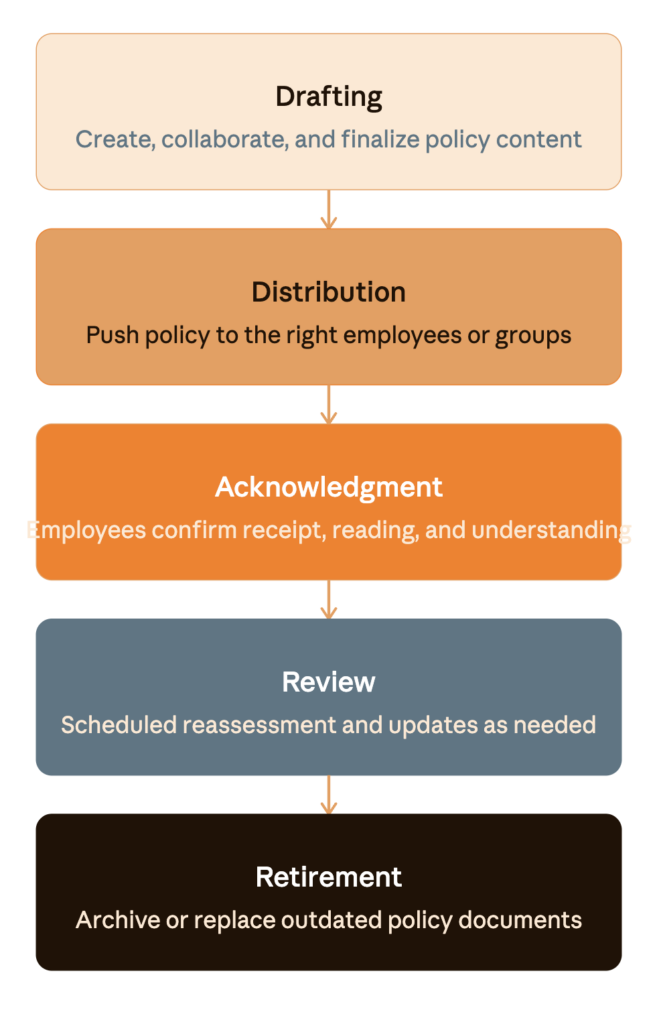
Purpose-built policies and procedures software manages and structures the full policy lifecycle – yes, including organized document storage! The system covers everything from drafting through policy and procedure distribution, acknowledgement, scheduled review, and eventual retirement. It also automates many of these steps, lightening administrative burden and reducing bottlenecks. For example, policy management software automatically tracks review deadlines, taking the responsibility off of individual document owners to remember and implement that process.
5. Accountably Establish Expectations
A policy that employees cannot access or have never read provides almost no compliance value, regardless of how well-written that policy actually is. Centralized policy and procedures management software gives employees a single, searchable policy library, accessible from any device.
Software solutions also use features like acknowledgement tracking and comprehension texts, which create a documented record proving that employees received, read, and demonstrated their understanding of key policies. This record matters both for ongoing compliance and in the event of any future disciplinary or legal proceedings. In those instances, having tested for comprehension creates a materially stronger record of policy communication and awareness.
6. Organized Audits
Who’s afraid of the big bad audit? Lots of people! For many organizations, an audit can trigger a mad scramble to locate current policy versions, reconstruct distribution records, and present program rigor that was never actually built.
With policy and procedures software in place, the audit trail automatically builds itself continuously, as a byproduct of normal operations. Reports on acknowledgement rates, version history, and review schedules become available on demand. That level of continuous documentation not only guarantees audit readiness, it also shortens audit cycles, generating time (and cost) savings.
7. Limit Whiplash From Regulatory Changes
In regulated industries, keeping internal policies current and compliant with external requirements is absolutely crucial. It’s also quite a challenge, especially for businesses without the proper system in place. When handled manually, it can take weeks to update, redistribute, and re-collect acknowledgements for a revised policy.
Software compresses this cycle dramatically. Using policy and procedures software, administrators can update a policy, push it to affected groups, and begin collecting fresh acknowledgements on the same day they learn of the changes requiring that revision. Ultimately the gap between a regulatory change and documented organization response is as only as long as your update process. Policy and procedures software makes that process very short.
8. Detailed Documentation
Recordkeeping can make or break a business. If an oversight body or potential partner asks how your organization makes sure that workers follow stated policies, hopefully your answer is more comprehensive than “we send emails.”
Having a well-documented, auditable policy program demonstrates that your business sees compliance as part of an established system, not some lofty goal. In industries such as healthcare where patient safety, financial integrity or customer data are potentially at stake, that distinction matters hugely to regulators and potential business partners alike. A business’s reputation often rests on its ability to produce documented evidence over a reliance on unproven assurances .
9. Cut Down on Administrative Cost
Think of all the time-consuming individual steps required by manual policy and procedure management workflows. Print documents, distributing them, collecting signatures, following up, resending, filing…That’s a lot of work, and many organizations carry it as invisible overhead simply because no one has ever bothered adding up what that invisible overhead costs.
Automating these workflows frees HR and compliance teams from rote process execution tasks so they can focus on work that requires actual human thought and judgement. Organizations that automate compliance workflows report significant reductions in time spent on manual admin work. Saved time is also saved money, and those savings compound over time. Fewer incidents mean less remediation, audit readiness leads to shorter audit cycles, and improved employee comprehension means fewer errors working their way into operations – and into your books.
10. ComplianceBridge Has Your Back!
Organizations that know how to manage policy well are one and the same with companies with the right systems in place. Those systems keep policies current, guarantee that those policies get to the right people, and produce accountability records that will hold up when something goes wrong. Policy and procedures software establishes those systems by creating an infrastructure that turns a document library into an actual compliance program.
Picking through all of the available software options out there can get real overwhelming real fast, which is why our tenth and final benefit is this: ComplianceBridge already has everything you need to succeed! Our policy and procedure management software gives users seamless management over the entire policy lifecycle, from creation through distribution.
Our software features built-in review dates, expiration dates, and automated reminders so nothing ever gets missed or forgotten. ComplianceBridge also makes collaboration easy, allowing multiple stakeholders able to refine policies in a single document with clear ownership and version controls.
Once a policy is finalized, distribution is a matter of simply. The system then allows you to track acknowledgment, test employee understanding with customizable quizzes, and analyze compliance data in real time, using advanced metrics and reporting tools.
Contact ComplianceBridge for a demo today to discover the full list of ways we can help your business!